Maulana Abul Kalam Azad’s Unfinished Work of Inclusive India
Maulana Abul Kalam Azad’s doctrine of the unity of religions rests on a classical and defensible Islamic distinction between the single din that every genuine prophet was sent to establish and the plural shariahs suited to the particular needs of different communities and ages
There is a particular kind of religious thinking that only gets written in dangerous times. It is not produced at leisure in a seminary library, weighing hypotheticals for an audience of fellow specialists. It is produced because a community is under pressure, because neighbours who have prayed differently for a thousand years are being told, from several directions at once, that they cannot possibly belong to the same nation, and because someone with the scholarly equipment to answer that claim on its own terms feels compelled to do so. Maulana Abul Kalam Azad’s theology of religious unity belongs to this second, more urgent category. It was drafted in colonial prisons, serialised in a banned newspaper, and delivered, in its final and most desperate form, from the steps of Delhi’s great mosque to a congregation that was already packing its bags for Pakistan. To read Azad (1888-1958) today only as a nationalist statesman who happened to dabble in Quranic commentary is to miss what made his politics durable in the first place: a patiently argued, textually disciplined case that the God of the Quran does not divide humanity into permanently separate nations, and that a Muslim who reads his own scripture honestly has no warrant for believing otherwise.
Azad, it will be argued, is best understood as a hinge figure between these two worlds: a classically trained alim who read the Quran with the discipline of a traditional exegete, yet who arrived, through that very discipline, at a doctrine of shared religious origin sturdy enough to carry the weight of a nation’s founding argument against its own dismemberment. The essay also takes seriously the tensions in that doctrine, because an honest account of Azad’s thought gains nothing from smoothing over its difficulties, and because those difficulties are themselves instructive for anyone trying to build interfaith solidarity today, in India or elsewhere, on a foundation that will actually hold.
A Life Written Between Prison and Print
Abul Kalam Ghulam Muhiyuddin Azad was born in Mecca in 1888 into a family of considerable religious standing; his father, Maulana Khairuddin, was a scholar and Sufi of the Qadiri-Naqshbandi lineage with disciples scattered across northern India. The family returned to Calcutta while Azad was still an infant, and he was raised entirely within the traditional curriculum of the Islamic sciences, mastering Arabic, Persian, tafsir, hadith and kalam under private tutors, without ever setting foot in a modern school. That last fact would later be held against him by critics who found it improbable that a man with no formal Western education should become independent India’s architect of universities and scientific institutes. Yet this traditional formation coexisted, almost from adolescence, with real intellectual restlessness: Azad broke early with the unreflective deference to inherited authority that characterised much of his upbringing, taught himself English, and read widely in the modernist and Pan-Islamic literature of his day, including the anti-imperialist writings of Jamal al-Din al-Afghani and Muhammad Abduh.
His public career began not in a political party but at a printing press. In 1912 he launched the Urdu weekly ‘Al-Hilal’, a paper that broke sharply with the loyalist tone of most Muslim journalism of the period, denouncing British rule and preaching Hindu-Muslim unity as a matter of religious duty rather than political convenience. It achieved a circulation that alarmed the colonial state, which banned it in 1914. What distinguished ‘Al-Hilal’ from other reformist Muslim journalism of the era was not its anti-colonialism, which plenty of papers shared, but the confidence with which Azad wrote as a trained scholar addressing fellow Muslims in their own theological idiom, reasoning from the Quran and the precedent of the earliest Muslim community rather than from a borrowed, secularised vocabulary of common citizenship. It was a strategy he sustained for the rest of his life.
Interned at Ranchi from 1916 to 1920 under wartime restrictions, Azad used the enforced leisure of confinement to begin what would become his most enduring theological legacy: a systematic new commentary on the Quran, the ‘Tarjuman al-Quran’, conceived not as a verse-by-verse gloss in the conventional style but as an extended meditation on the Quran’s fundamental purpose. The manuscript was seized by British authorities on at least three occasions between 1916 and 1921, and each time Azad had to reconstruct years of work from memory; he compared his own ordeal, in the preface to the first edition, to that of Thomas Carlyle, whose manuscript of ‘The French Revolution’ was accidentally burned and had to be rewritten in its entirety (Azad, ‘Tarjuman’, p.xxix-xxx). The completed first volume, covering only Surah al-Fatiha, the Quran’s opening chapter, appeared in 1930; further material followed in 1936, and both were revised during a later imprisonment at Ahmednagar Fort during the Quit India movement. A planned third volume was left unfinished at Azad’s death in 1958 and has never been recovered (Syed Mahmud, p.x-xi). That the surviving portion of a lifetime’s exegetical ambition amounts to a commentary on one short chapter is a fact worth sitting with, because it tells us how much theological weight Azad believed those seven verses could bear.
By the early 1920s he had moved from journalism into organised politics, articulating at the Khilafat conference in Agra in 1921 the idea that would define his career: that Hindus and Muslims, whatever their theological differences, could and should constitute a single political nation, bound by centuries of shared history rather than by uniformity of belief. He was elected president of the Indian National Congress in 1923, at thirty-five, and again from 1940 to 1945, a second tenure that placed him at the helm of the party through the Quit India movement and the fraught negotiations that preceded Partition. After independence he became India’s first minister of education, a post he held until his death in 1958, in which capacity he laid the institutional foundations of much of the country’s higher education and scientific infrastructure, including the University Grants Commission and the Indian Institutes of Technology.
The Grammar Beneath the Argument: Deen and Shariah
None of Azad’s political interventions can be understood apart from a single piece of exegetical grammar that runs through everything he wrote: the distinction, drawn from classical Quranic scholarship and sharpened by Azad into a load-bearing theological principle, between ‘deen’ and ‘shariah’. Deen, in this reading, is the substratum of belief and moral obligation common to every genuine prophetic mission, from Adam to Muhammad: belief in one God, in the reality of moral accountability, and in a shared ethical core of justice, compassion and truthfulness. Shariah, by contrast, is the particular law, ritual and social ordinance given to a specific community at a specific time, tailored to its circumstances and therefore naturally variable across history. The basic religion, on this account, never changed; only its detailed application did.
This distinction is not a modern apologetic invention improvised to meet the demands of Indian communal politics; it has a long pedigree in classical exegesis. Its scriptural anchor is Quran 42:13, in which God is said to have prescribed for prophet Muhammad’s community the same religion enjoined upon Noah, Abraham, Moses and Jesus, with the instruction that this religion be established and not divided. Sayyid Abul A’la Maududi, commenting on this verse in his ‘Tafhim al-Quran’, argued that no prophet ever brought a wholly new din; each one reaffirmed a single religion that had always come from God, and the naming of five prophets is illustrative rather than exhaustive. Maulana Wahiduddin Khan, reading the same verse against Quran 5:48 — where God states that had He willed He could have made humanity a single community, but chose instead to appoint for every people a law and a way, in order to test each by what it had been given — concludes that the Quran holds these two truths together without contradiction: one din, expressed through a plurality of shariahs, each suited to its age. Syed Sulaiman Nadwi makes essentially the same point when he describes the prophets, from first to last, as bearers of a single unbroken teaching, obscured over time by the quarrels and alterations of the communities entrusted with it.
Two further commitments follow from this framework, and both matter for what Azad would later build on top of it. The first concerns the Muslim’s obligation to believe in earlier scripture: The Quran requires belief in the Torah, the Psalms and the Gospel by name, and in the general fact of prior revelation more widely, which supplies a positive vocabulary — People of the Book — for describing communities outside Islam that carries real social and legal consequences rather than mere toleration. The second concerns the disposition this theology is meant to cultivate in the believer: not simply intellectual assent to a proposition about the history of revelation, but a practical ethic of dialogue and coexistence, since a tradition that regards the deepest teachings of its neighbours as cognate with its own has correspondingly less warrant for contempt towards them.
It is worth being precise about how narrow, and for that reason how sturdy, this theology actually is. The claim is not that every religion as currently practised is equally true, nor that every scripture now in circulation is equally authentic, nor that the specific legal content of another tradition binds a Muslim in any way. The claim is only that the fountainhead of religious truth is one, and that what divides humanity today into competing communities of faith is a matter of historical elaboration rather than of original substance. This is the theology Azad inherited from the classical tradition, radicalised in its application, and made the foundation of a project that was simultaneously exegetical and political.
Reading the Fatiha: A Universal God at the Very Threshold of Scripture
Azad’s most sustained theological labour went into the opening chapter of the Quran, the seven verses of Surah al-Fatiha that every Muslim recites in every unit of prayer. His commentary treats this brief passage as a tightly compressed statement of the Quran’s entire ideological programme, in keeping with its traditional titles Umm al-Quran, the mother of the Quran, and Asas al-Quran, its foundation (Azad, ‘Tarjuman’, p.5). The commentary is organised around a sequence of divine attributes named or implied in the Fatiha’s opening lines, and it is worth walking through them in order, because Azad’s inclusivism is not asserted as a conclusion but built, brick by brick, from the ground up.
He begins with ‘hamd’, the word for praise with which the surah opens, and observes that the word denotes the most beautiful and considered form of praise — precisely the kind of praise that cannot coherently be offered to a capricious or vindictive deity. A being who is ‘mahmud’, worthy of beautiful praise, Azad argues, cannot simultaneously be an object of mere terror, and this is a deliberate corrective to what he takes to be one of the oldest errors in human religious history: founding devotion on fear rather than on gratitude at manifest goodness (Azad, ‘Tarjuman’, p.8). He then traces the word Allah itself through the common Semitic root it shares with the Hebrew ‘Eloha’ and the Aramaic ‘Ilahia’, arguing that the Quran adopted an existing Arabian usage for a supreme being standing above the tribal deities, rather than inventing a sectarian name for God (Azad, ‘Tarjuman’,p.14-16). Even this etymological point does real theological work, because it lets Azad present the Quranic God, from the very first word, as continuous with the deepest religious intuitions of humanity generally, rather than as the exclusive property of one people.
The concept that receives the most extensive treatment, and that carries the greatest weight in Azad’s argument, is ‘Rububiyat’, usually translated as providence but retained by Azad in Arabic because no single English word captures it. Rububiyat denotes not the bare fact of creation but the ongoing, graduated, need-sensitive process by which every existing being is nourished according to its own inherent capacities — the pattern, Azad suggests, visible in a mother’s care for her infant as its needs change from milk to solid food, from being carried to being taught to walk, written large across the whole of creation (Azad, ‘Tarjuman’, p.20-21). The theological weight of this idea lies in the title with which the Fatiha addresses God: ‘Rabb al-Alamin’, Lord of all Being, or Lord of all the Worlds. Azad reads this title as a direct rejection of every tribal, national or sectarian conception of divinity, insisting that it requires the believer “to acknowledge the universal character of divine concern for every individual, group, community, country and every form of existence,” and that it “puts an end to all notions of exclusiveness which had hitherto prevailed among mankind assigning divine blessings and favours to one’s own community” (Azad, ‘Tarjuman’, p.8). This is the first pillar of Azad’s inclusive theology: the very object of worship named at the outset of the Quran is defined in terms that make communal appropriation of the divine impossible in principle.
Building on this, Azad turns to ‘Rahmat’, the twin divine names Compassionate and Merciful, grouped under the single heading of divine benevolence. Here he undertakes an extended, and for its time unusual, discussion of the relationship between the Quran and the Christian Gospel, arguing that there is fundamentally no conflict between the two at the level of moral and spiritual substance, and that any divergence lies in the historical neglect and distortion of Christ’s original message by later followers — a pattern Azad regards as recurring across religious history generally rather than peculiar to Christianity. This comparative move is characteristic of his method throughout: rather than adjudicating between religions by asserting the exclusive truth of one against the falsity of others, he consistently locates points of divergence in the vicissitudes of historical transmission, while affirming a common moral core.
The fourth attribute, ‘Adalat’, divine justice, comes from the verse addressing God as “Master of the Day of Recompense.” Azad argues at length that the word ‘din’ in this specific verse denotes law or natural requital rather than an arbitrary sentence handed down in anger: “it is not fair,” he writes, “to assert that God deals out punishment to any one out of revenge or in anger,” since the term here means simply “what follows as a natural sequence,” and, in the Quranic scheme, “justice… is not a negation of mercy. It is mercy itself” (Azad, ‘Tarjuman’, p.9). This establishes, prior to any explicit discussion of religious plurality, a picture of divine governance as lawful and morally coherent rather than a matter of arbitrary favour bestowed on one community and withheld from others.
The sixth section, greatly expanded in the 1945 edition, is devoted to ‘Tawhid’, the unity of God, and it is here that Azad’s comparative method becomes most explicit. Rather than presenting the oneness of God as a doctrine unique to Islam and opposed wholesale to other civilisations’ theologies, Azad surveys, according to the surviving chapter headings, the Chinese concept of the divine, Hindu thought, Central Asian shamanistic belief, Iranian Magianism, the Judaic concept, and Greek philosophy, before arriving at what he calls the Quranic articulation of transcendence. His conclusion, signalled in the rubric “One Concept for All,” is that these various historical elaborations, for all their surface diversity, converge on a single underlying intuition of a transcendent, personal, morally purposive reality — an intuition the Quran expresses with unmatched clarity, in Azad’s judgement, but does not monopolise.
It is the seventh and final section, ‘Hidayat’, divine guidance, that draws these threads into an explicit doctrine of religious unity. Its chapter headings alone sketch the argument: the unity of religion in the Quran, the pristine original unity of humankind, disunity following upon revelation’s neglect, the distinction between din and shariah, and finally the meaning of ‘sirat al-mustaqim’, the straight path invoked in the Fatiha’s fifth verse. Here Azad advances a reading that departs sharply from the great majority of classical commentators, who identify the straight path specifically with Islam or with the community of Muhammad. For Azad, the straight path is the path of Rabb al-Alamin as such — the universal Lord — and is therefore not the exclusive property of any single historical religious community. This is the exegetical hinge on which his entire theology of religious unity turns: having established, from the Fatiha’s own vocabulary, that God is by definition the Lord of every people, Azad concludes that the path to that God cannot, by the same logic, belong to only one of them.
Wahdat-e-Din: What it Claims and What it Does Not
Azad gave this doctrine a name, ‘wahdat-e-din’, the unity of religion, and scholars who have studied his exegesis closely have been careful to specify exactly what the term does and does not commit him to. The Centre for Study of Society and Secularism summarises his position as distinguishing din, defined as belief in one God, in angels, in the Day of Judgement, in prophets and in revealed scripture, from shariah, where “significant differences… of all religions” are freely acknowledged; his emphasis falls “on metaphysical doctrines on one hand, and on value-structures of religions, on the other”. Nanang Nurcholis puts the same point in language close to Azad’s own: “all religions in origin contain the truth and are pervaded with the same spirit,” while the “outward path… may vary according to the circumstances,” so that differences between religions are differences “in the manner of giving effect” to a shared basic provision, not differences in that provision itself.
It is worth pausing on a caution that recurs across the secondary literature, because it protects Azad’s theology from being flattened into something looser and less defensible than what he actually argued. His own term is ‘wahdat-e-din’, unity of religion in the singular, and commentators disagree about whether this can properly be equated with the stronger and more theologically permissive doctrine of ‘wahdat al-adyan’, the unity of religions in the plural, associated in the Islamic mystical tradition with figures such as Ibn Arabi. Ghulam Rasool Dehlvi observes that whether Azad’s proposition can be conflated with the stronger claim “is debatable,” but that his intent was clear enough: to reduce communal conflict between adherents of two very different religions sharing one country. Azad’s caution here is easily lost in more enthusiastic retellings of his pluralism. He did not claim that Hinduism as historically elaborated — its image worship, its caste ordering of society — was thereby endorsed by Islam; what he claimed was that beneath and prior to this historical elaboration lay an original impulse toward the sacred that Islam was bound to respect rather than simply dismiss.
This qualification places Azad in a specific position within the standard typology used in comparative theology to describe responses to religious diversity. Exclusivism confines saving truth to one tradition alone; pluralism holds that many traditions offer independently valid, and in some versions equivalent, paths to the same reality, without privileging any one as final; inclusivism, the middle position, holds that saving truth may genuinely be present in other traditions even while one tradition is regarded as its most complete and normative expression. Measured against this scheme, Azad is an inclusivist in a fairly precise sense. He affirms, on independent Quranic grounds, that Jews, Christians, Sabeans and, by extension of his comparative treatment of Tawhid, sincere adherents of other traditions who hold to belief in God, the Last Day and righteous conduct stand in a genuine relationship with Rabb al-Alamin, while continuing to hold that the Quran discloses this relationship, and the primordial din underlying it, with a completeness not equalled elsewhere. This is a significant achievement, and a courageous one for its time, but it should not be mistaken for the more radical claim that any sincerely practised religion is as reliable a path to God as any other regardless of content.
The scriptural evidence Azad marshals for this inclusivist claim is worth setting out, because it shows the case is not merely asserted but built cumulatively from specific verses. Quran 2:62, repeated with slight variation at 5:69, states that believers, Jews, Christians and Sabeans alike, whoever truly believes in God and the Last Day and does righteous deeds, shall have his reward with his Lord and shall know neither fear nor grief. Generations of commentators strained to read this verse restrictively, applying it only to believers who then accepted Muhammad’s message; Azad’s exegesis, by contrast, lets the verse mean roughly what it says. Quran 22:67 states that for every community God has appointed rites which they observe; Quran 5:48 states that had God willed He would have made humanity a single community, but instead willed to test each by what it was given. Read together with Quran 3:64, which calls Jews and Christians to a common word centred on the worship of God alone, and Quran 29:46, which instructs Muslims to dispute with the People of the Book only in the best manner, since “our God and your God is one,” these verses form, in Azad’s hands, a coherent cumulative case that sincere monotheism and righteous conduct, wherever found, stand in a real relationship with divine mercy — because they are themselves the substance of the one din God has always required.
Beyond the Abrahamic Frame: Azad and the Hindu Tradition
A doctrine of religious unity built entirely on Quranic material about Jews, Christians and Sabeans would remain, for all its interest, of limited use in the Indian context that most occupied Azad, since India’s plurality is overwhelmingly Hindu, Sikh, Jain and Buddhist rather than Abrahamic. Azad’s wahdat-e-din was never confined, by him or by his contemporaries, to the Abrahamic family. Dehlvi is explicit that Azad’s idea focused on the unity of din “without excluding the essential messages and universal values of the non-Semitic religions — Hinduism, Buddhism and Jainism”. This extension required an interpretive step beyond the letter of verses naming specific communities known to seventh-century Arabia, toward the underlying principle those verses were taken to establish: that sincere monotheism, ethical seriousness and belief in ultimate accountability, wherever genuinely found, participate in the single din that is the substance of every authentic revelation, whether or not that revelation is named in the Quran itself.
This reading did not emerge from nowhere. India had its own long indigenous tradition of religious universalism to draw on, from the Mughal emperor Akbar’s short-lived syncretic order Din-i-Ilahi to the broader climate of Bhakti and Sufi devotionalism associated with figures such as Kabir and Guru Nanak, in which the distinction between Ram and Rahim is treated as a matter of naming rather than of ultimate substance. Azad’s formal, exegetically disciplined wahdat-e-din is a different kind of achievement from this devotional syncretism — it proceeds from tafsir rather than mystical poetry, and is more careful to preserve orthodox Islamic boundaries — but it drew on the same underlying cultural intuition that had made composite religious sensibility unusually available in the Indian environment.
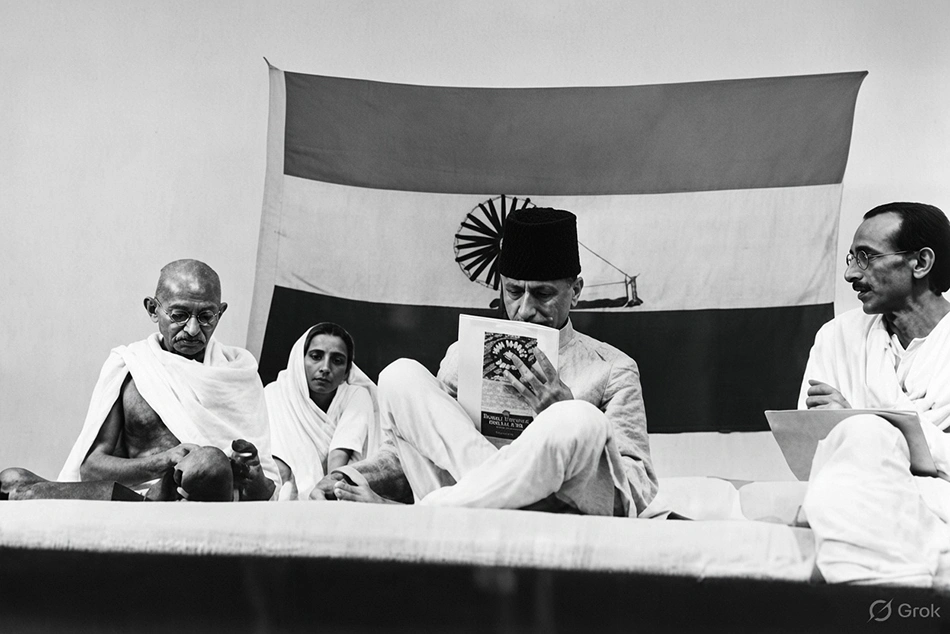
Azad’s closest political collaborator, Mahatma Gandhi, arrived at a structurally similar position from within the Hindu tradition, articulated as ‘sarva dharma sama bhava’, equal regard for all religions: the conviction that every major faith offers a genuine path to the same ultimate truth, and that a devout adherent of one tradition owes the traditions of others not mere toleration but active respect. The affinity between Gandhi’s Hindu universalism and Azad’s Islamic wahdat-e-din supplied much of the theological common ground on which their decades-long political partnership rested, and it helps explain why Azad, virtually alone among the senior Congress leadership, continued to resist Partition even after Gandhi’s own opposition had, under the pressure of events, become more equivocal. It also illustrates a broader point: doctrines of religious unity rarely emerge from a single tradition reasoning in solitude. They tend to arise, as both men did, from sustained proximity and genuine encounter between traditions under shared historical pressure.
From Tafsir to Politics: Composite Nationalism and the Jama Masjid Speech
It would be a mistake to treat Azad’s theology and his politics as two separate commitments that happened to coexist in one biography. The scholarly consensus is that the theology generated the politics, not the reverse: his advocacy of a joint national life for Hindus and Muslims rested on a considered reading of the Quran’s teaching about the origin and destiny of religious communities, rather than on pragmatic calculation dressed up afterwards in religious language. This is the significance of the concept Azad introduced at Agra in 1921 and elaborated across two decades: composite nationalism, the idea that Hindus and Muslims, despite genuine theological differences, could and should constitute a single political nation bound by shared history, shared culture and shared destiny rather than by uniformity of belief.
Azad’s most sustained public statement of this vision came in his presidential address to Congress at Ramgarh in March 1940, delivered within days of the Muslim League’s Lahore Resolution calling for separate Muslim homelands. He opened by asserting his own Islamic identity, describing himself as conscious of inheriting thirteen hundred years of Islamic civilisation, and then turned this assertion into the ground of a second and equally deep claim: that he was, with no less conviction, an Indian, an integral part of the indivisible unity of the Indian nation, strengthened rather than weakened by the spirit of Islam itself. “Our shared life of a thousand years,” he told the delegates, “has forged a common nationality,” adding that no artificial mould could construct such an amalgam and no false idea of separatism could now break it apart. The historian Irfan Habib has read this address as a direct rebuttal of the exclusivist, faith-based nationalism then being pressed from two directions at once — by Hindu nationalists such as V. D. Savarkar and by the Muslim League’s two-nation theory — both of which treated religious community as coextensive with political nationhood.
If the Ramgarh address stated the theology’s political implications in the register of oratory, the crisis of Partition tested them in the register of pastoral emergency. On 23 October 1947, on the occasion of Bakrid, Azad addressed a vast crowd of anxious Delhi Muslims from the steps of the Jama Masjid, many of them preparing to abandon their homes for Pakistan. The speech is remembered less for its argument than for its register: not the cool exposition of a Quranic commentator but the anguished appeal of a man watching his life’s theological and political project collapse in real time, and refusing, even so, to concede that it had been mistaken. He reminded his listeners of their own history in the city, recalled that it was only the day before, in historical terms, that their forebears had performed their ablutions on the banks of the Yamuna, and insisted that today’s fear was as misplaced as yesterday’s exultation had been. He urged them not to seek reassurance from the new custodians of power and told them plainly that if they did not wish to flee, no one could compel them to. According to those who have studied the speech, he invoked a hadith to the effect that God has made the whole earth a place of worship, using it to argue that Muslim belonging in India required no one’s permission. His central message, distilled by later commentators into a single sentence that has become a touchstone in Indian public memory, was that Muslims should have faith in India, that the country belonged to them, and that any fundamental decision about India’s destiny would remain incomplete without their consent.
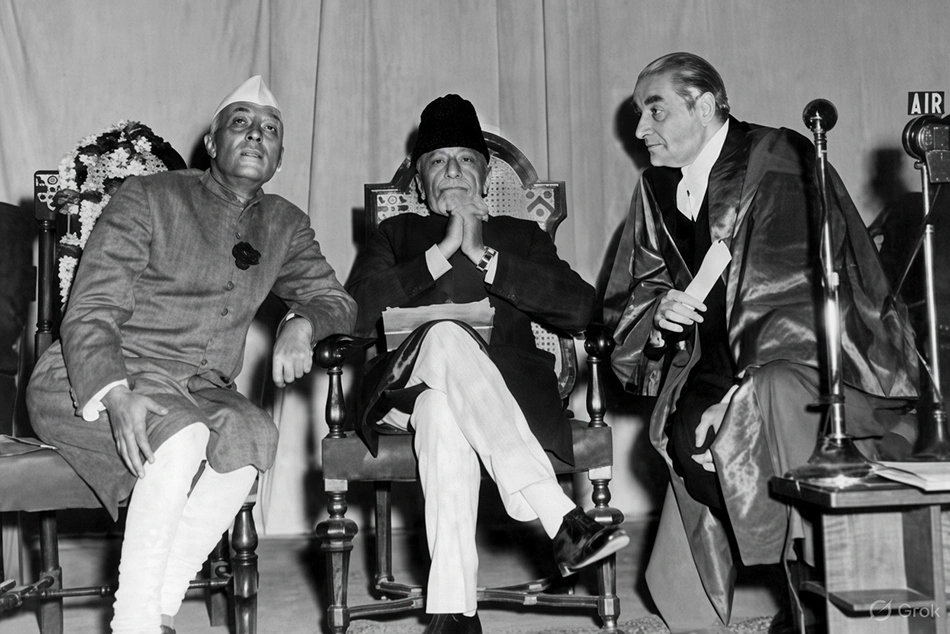
The speech deserves to be read as the practical and pastoral counterpart to the Fatiha commentary’s theoretical argument. Where the exegesis had argued, in the register of scholarship, that the God of Islam and the God encountered by other sincere believers were one, the speech applied that argument, in the register of crisis counselling, to a specific and devastated community facing an irrevocable choice. Azad remained, by most accounts, virtually alone among the first rank of national leaders in his unbroken opposition to Partition even after Gandhi, Nehru and Patel had, for their several reasons, accepted its inevitability. Whether or not any single speech can be credited with the historical weight later memory has assigned it, its persistence testifies to how completely Azad’s theology of religious unity had, by 1947, become inseparable from his political identity.
Azad and Islamic Liberation Theology
Azad wrote and acted a generation before the term “Islamic liberation theology” had been coined, but the framework developed by later scholars, most influentially the South African exegete Farid Esack, offers a productive lens for understanding what Azad was doing, and what distinguishes his project from more purely doctrinal accounts of pluralism. Esack’s ‘Quran, Liberation and Pluralism’, written against the backdrop of the anti-apartheid struggle, argues that Quranic pluralism cannot be adequately understood as an abstract proposition about the epistemic status of other religions; it must be read as a hermeneutic of solidarity, forged in the concrete experience of oppressed communities of different faiths standing together against a common structure of injustice. For Esack, the operative Quranic categories are not merely doctrinal — who will be saved, whose scripture is authentic — but praxis-oriented: who stands with the oppressed, and on what textual basis can a Muslim justify solidarity with non-Muslims engaged in that same struggle.
Azad’s situation was not South Africa under apartheid, but colonial and immediately post-colonial India presented its own structure of oppression, against which Hindus and Muslims together had reason to make common cause, first against an occupying imperial power, and then against a communal politics that threatened to fracture the newly independent nation along exactly the lines colonial administration had long found useful to draw. Read in this light, Azad’s wahdat-e-din performs precisely the function Esack ascribes to a liberationist hermeneutic: exegesis that cannot be separated from the political solidarity it was designed to make theologically possible. Azad did not first work out an abstract doctrine of religious unity and then, as an afterthought, apply it to Indian politics; he read the Quran, from his earliest journalism onward, with the practical question of Hindu-Muslim solidarity against oppression already in view, and it is not too much to say that this question shaped which verses he found himself dwelling on and how he construed them. This is not a mark against his exegesis, any more than it would be against Esack’s; it is the defining feature of a liberationist rather than a purely academic hermeneutic, one that reads scripture from within a struggle rather than from a position of detached neutrality above it.
It is worth being precise, though, about where Azad’s project and the fuller apparatus of contemporary liberation theology diverge, because an honest interreligious reading gains nothing from flattening real differences into an undifferentiated pluralism. Esack’s hermeneutic, developed for a context of shared oppression under a single unjust regime, subordinates questions of theological “in” and “out” to the more urgent question of who stands against injustice in the present moment — a category, in principle, indifferent to formal religious affiliation altogether. Azad’s wahdat-e-din remained, by contrast, a doctrine about the shared theological origin of specific historical religions, and never extended into the more radical, praxis-first register in which solidarity itself, rather than shared prophetic ancestry, becomes the operative theological category. There is a further contrast worth drawing concerning political horizon: Esack’s hermeneutics served a struggle whose objective was dismantling an explicitly religious and racial hierarchy imposed by a minority regime; Azad’s hermeneutics of unity served the construction of a new and religiously plural state emerging from colonial rule — not primarily the dismantling of an existing unjust order in the name of the oppressed, but the theological legitimation of a shared political future for communities that colonial policy, and subsequently communal politics, had worked hard to persuade were incapable of sharing one. Both theologies are liberationist in the broad sense of using scripture to authorise solidarity against structures that scripture’s opponents also claimed to speak for in religion’s name, but they serve different immediate tasks — resistance in one case, nation-building in the other — and this difference helps explain why Azad’s theology remains, in the respects already discussed, more conservative in its formal doctrinal commitments than Esack’s.
Deen, Shariah and the Ethics of Pluralism: The Maqasid Connection
A further strand worth drawing into this account, because it clarifies what practical work Azad’s distinction between deen and shariah was meant to do, is the classical tradition of ‘maqasid al-shariah’, the higher objectives of Islamic law. This tradition, associated above all with the fourteenth-century Andalusian jurist Abu Ishaq al-Shatibi, shifted the focus of Islamic jurisprudence from the letter of legal commandments to their underlying purposes, on the conviction that “every legal ruling in Islam has a function which it performs,” tied to an overarching aim “to realise benefit to human beings, or to ward off harm or corruption” (Alwani, p.xi). Five objectives are traditionally identified: the protection of life, faith, intellect, family and wealth, to which the Tunisian scholar Ibn Ashur later added a sixth, freedom (Ibn Ashur, p.155). What this framework supplies, in the context of Azad’s theology, is a way of explaining why the variation in shariah across communities need not be read as evidence of contradiction rather than of divine wisdom: if the objectives behind the law are what matter, then a law suited to one community’s circumstances can serve the same underlying purposes as a differently shaped law suited to another’s, without either implying that the other’s purposes, or its people, are less worthy of protection.
This connects directly to pluralism as a lived value rather than merely a doctrinal position. A community attentive to maqasid will treat the preservation of another community’s faith, intellect and family life as falling within its own religious concerns, not as someone else’s separate business. It is this move — from a doctrine about the shared origin of religion to an ethic of protecting the conditions in which every community’s religious life can flourish — that gives Azad’s theology its practical edge, and that connects his classical exegesis most directly to Esack’s later, more overtly political hermeneutic of solidarity. Both, in their different ways, insist that a right understanding of divine law issues an obligation to protect and dignify communities beyond one’s own, not merely to tolerate their existence at arm’s length.
Comparative Perspectives: Sufi Universalism, Modernism and Iqbal
Maulana Azad’s theology becomes clearer when set against three points of comparison. The nearest classical antecedent to his wahdat-e-din is the Sufi doctrine associated with Ibn Arabi, whose thirteenth-century writings warn against restricting oneself to one particular religion and disbelieving in everything else, since God is greater than to be comprehended by one belief to the exclusion of others. This mystical universalism reached India through figures such as the eighteenth-century Naqshbandi Sufi Mazhar Jan-e-Janan, reported to have accepted Ram and Krishna as prophets sent by God to their own peoples. Azad’s theology shares with this tradition the conviction that divine truth exceeds any single historical formulation, but differs in method: where Ibn Arabi’s universalism rests on a metaphysics of divine self-disclosure that can blur the boundary between religions altogether, Azad’s wahdat-e-din is presented as an exegetical conclusion drawn from close reading of specific verses and a careful lexical distinction between din and shariah, one that explicitly preserves the practical and legal distinctiveness of each shariah tradition even while affirming their common root.
The second comparison is with Sayyid Ahmad Khan, the founder of the Aligarh reform movement and an early influence on Azad. The two shared a conviction that the Quran does not conflict with reason or with the discoveries of modern science; Azad insisted that the aim of the Quran is to draw attention to divine power and wisdom, not to offer a scientific exposition of the universe. Yet Azad arrived independently at a theology of religious pluralism largely absent from Sayyid Ahmad Khan’s more narrowly educational reform programme.
The third and most instructive contrast is with Muhammad Iqbal, Azad’s most prominent intellectual contemporary among Muslim thinkers of the subcontinent. Both sought to reconstruct Islamic thought for the modern age through close engagement with the Quran, but Iqbal’s philosophical reconstruction moved toward a metaphysics of the dynamic, creative self and, especially in his later career, toward support for separate Muslim political development in India — a trajectory in direct tension with Azad’s composite nationalism. Allama Iqbal argued that Islam’s universal reach made it unbound by territorial borders, and that nationalism in the European sense risked cutting asunder the unity of the Muslim ummah. Maulana Husain Ahmad Madani of the Deoband seminary took the opposite view, arguing for composite nationalism on the precedent of the Prophet Muhammad’s alliance with the Jewish tribes of Medina — a vision he called ‘muttahida qaumiyat’, and one much closer to Azad’s own. This tension between Iqbal and Madani, replicated within Azad’s own thought as an argument he had to win rather than a premise he could simply assume, illustrates that the classical din-shariah distinction, on its own, settles nothing about politics; it is a piece of exegetical grammar capable of generating very different political theologies depending on further commitments an interpreter brings to it.
Critical Assessment: The Tensions Worth Naming
No honest account of Azad’s theology can avoid the objections it drew, both in his own time and since, because those objections illuminate genuine difficulties rather than merely his critics’ hostility. The first and most persistent charge, levelled by sections of the ulema who were otherwise his political allies, was that wahdat-e-din risked collapsing the specific claims of Islamic revelation into an undifferentiated religious universalism that Muslim theology has traditionally resisted. Sympathetic scholars have argued this charge rests on a misreading, since Azad’s doctrine, properly stated, distinguishes the unity of original revelation from any claim about the equal validity of religions as historically constituted, and leaves entirely intact the specifically Islamic claims — the finality of Muhammad’s prophethood, the integrity of the Quranic text, the binding character of Islamic law for Muslims — that his critics feared he would relativise. It remains true, nonetheless, that the line between wahdat-e-din and the more expansive wahdat al-adyan is one that even sympathetic scholars acknowledge is debatable in Azad’s own texts, and that his rhetorical generosity toward other traditions sometimes outran the careful doctrinal fence he was, in principle, maintaining.
A second difficulty concerns the relationship between theology and political outcome. Because wahdat-e-din supplied the religious warrant for composite nationalism, and composite nationalism was, in the event, defeated by Partition, it is tempting to conclude that history delivered a verdict on Azad’s theology, and that the two-nation theory proved, whatever its intellectual merits, the more accurate reading of how deep and how mobilisable communal difference in fact was. This conclusion should be resisted, or at least heavily qualified. Partition was the product of a specific and contingent conjuncture of colonial policy, elite political competition and organised communal mobilisation, not a simple unfolding of theological logic; many of the same Deobandi scholars who shared Azad’s theological premises about the underlying unity of religion drew the same political conclusions he did and were, like him, defeated politically rather than refuted theologically. A doctrine’s truth does not stand or fall with its short-term political success, any more than a prophet’s message is falsified by his own generation’s rejection of it. The more defensible judgement is that Azad’s theology proved, in the India of the 1940s, insufficient on its own to withstand the combined weight of colonial divide-and-rule policy, elite Muslim League mobilisation, and an increasingly assertive Hindu nationalism that shared with the League, despite their mutual antagonism, the very premise Azad had spent his life contesting: that religious community and political nationhood must coincide.
A third and less often discussed difficulty concerns the gap between Azad’s inclusivist theology and the stronger, fully pluralist reading some later admirers have been tempted to read back into his work. Azad’s wahdat-e-din is a doctrine of shared origin, not a doctrine of equal validity; it licenses respect, dialogue and political solidarity, but not the claim that any sincerely practised religion is as reliable a path to God as any other regardless of its specific content. Azad remained, throughout his life, a practising and theologically orthodox Muslim, and scholars who wish to draw on his legacy for a more radically pluralist theology of religions are drawing on an intuition his work makes available, not on a position he explicitly held. This is not a criticism of those later readers, whose instincts may well be sound on independent grounds; it is a reminder that intellectual honesty requires distinguishing what a historical figure actually argued from what later readers, moved by his example, have gone on to argue in his name.
Relevance Today
Contemporary India, as several of the scholars drawn on throughout this essay note with evident unease, has seen a resurgence of precisely the premise Azad’s theology was built to refute, articulated now from a different direction than the one he principally opposed: the claim that authentic national belonging is coextensive with a single religious community, and that minorities occupy the nation on sufferance rather than as equal partners in its shared destiny. Read against this background, Azad’s insistence, at Ramgarh and again at the Jama Masjid, that Indian nationhood was the joint and indivisible achievement of every community that had settled and intermingled on Indian soil, and his prior insistence, in the Tarjuman al-Quran, that the God worshipped sincerely by any community stands in a real relationship to the God of Islam, together constitute not merely a chapter in intellectual history but a still-available theological resource for contesting exclusivist nationalism from within, rather than from outside, the vocabulary of religious conviction.
This is, arguably, the deepest continuity between Azad’s project and the liberationist hermeneutics considered earlier: both insist that scripture, read honestly and without fear, underwrites solidarity across religious lines rather than justifying walls between them, and both insist that this reading is not a concession wrung from religion by secular pressure but a discovery made within religion’s own deepest resources. In an age when religious difference is once again being conscripted, across the subcontinent and well beyond it, into the service of exclusivist nationalism, the case Azad constructed from the Quran itself — that the God worshipped sincerely by any community stands in a single, unbroken relationship with the God of every other — remains one of the more serious theological resources available for the older and harder work his life was spent upon: the work of tolerance, dialogue, human dignity and peaceful coexistence among people who have never agreed, and perhaps need never agree, on everything, but who share, on Azad’s reading of scripture, far more of their deepest convictions than the politics of division has ever been willing to admit.
There is also a quieter, institutional legacy worth setting alongside the theological one. When Maulana Azad became independent India’s first minister of education, he devoted himself to building institutions explicitly conceived as instruments of a shared, plural national culture rather than as vehicles for any single community’s cultural inheritance: The University Grants Commission, the Indian Institutes of Technology, the national academies of literature, music and the fine arts. This institutional legacy is the practical extension, in the register of statecraft, of the same wahdat-e-din that had earlier structured his exegesis and his opposition to Partition: an India whose cultural and educational infrastructure would belong equally to every community that had helped compose it, administered by a government that treated the diversity of the nation’s religious and cultural life as an asset to be cultivated rather than a problem to be managed or, worse, resolved by separation. That a man trained entirely within the traditional Islamic sciences, without a single day of formal Western schooling, should have become the architect of modern India’s premier scientific and academic institutions is itself a kind of embodied argument for the position he spent his scholarly life defending: that a serious grounding in one’s own religious tradition and a genuine, unforced commitment to the flourishing of a religiously plural society are not rival loyalties requiring an uncomfortable compromise, but two expressions of a single underlying conviction about the shared origin and shared destiny of the human religious quest.
Maulana Azad’s doctrine of the unity of religions rests on a classical and defensible Islamic distinction between the single din that every genuine prophet was sent to establish and the plural shariahs suited to the particular needs of different communities and ages. In the Tarjuman al-Quran, and above all in his long commentary on Surah al-Fatiha, he elaborated this distinction into a systematic reading of the Quran’s treatment of Jews, Christians and Sabeans, and by careful extension of the traditions of India, that kept open the possibility of divine mercy for sincere monotheists outside the Muslim community, while remaining, on the specific claims of Islamic revelation, entirely orthodox. He then carried this theology, without dilution, into the register of politics, making it the religious foundation of his doctrine of composite Indian nationalism, and he defended it at the greatest possible personal and political cost in October 1947, when he stood on the steps of the Jama Masjid and asked a frightened and grieving community to trust a vision of shared destiny that the events of the preceding weeks appeared, on the surface, to have already disproved.
Read in the spirit of Islamic liberation theology, Azad’s project appears as an early and instructive instance of a hermeneutic of interreligious solidarity forged, as Farid Esack’s later theology insists any authentic such hermeneutic must be, within a concrete struggle against shared oppression rather than in the safety of abstract theory. Read critically, it also reveals the genuine difficulty of holding a doctrine of religious unity in careful theological balance, resisting collapse on one side into an undifferentiated universalism that Islamic orthodoxy cannot sustain, and on the other into a merely instrumental political rhetoric detached from real conviction. Azad managed that balance as well as, arguably, any modern Muslim exegete has managed it, and the fact that his political project met defeat in 1947 is a judgement on the historical forces arrayed against him rather than on the theological argument he built. Two rivers, on his reading of scripture, have always flowed into one ocean; the harder and still unfinished work, in India and elsewhere, is building the kind of shared life in which that truth need not be relearned at the cost of so much grief before it is believed again.
Bibliography
Al-Raysuni, Ahmad. Imam al-Shatibi’s Theory of the Higher Objectives and Intents of Islamic Law. With an introduction by Taha Jabir al-Alwani. Translated from Arabic by Nancy Roberts. London; Washington, D.C.: International Institute of Islamic Thought, 2005.
Azad, Abul Kalam. The Tarjuman al-Quran. Vol. 1: Surat al-Fatiha. Edited and rendered into English by Syed Abdul Latif. 3rd ed. Hyderabad: Dr Syed Abdul Latif’s Trust for Quranic and Other Cultural Studies, 1981.
Esack, Farid. Quran, Liberation and Pluralism: An Islamic Perspective of Interreligious Solidarity against Oppression. Oxford: Oneworld, 1997.
Ibn Ashur, Muhammad al-Tahir. Treatise on Maqasid al-Shari’ah. Translated by Mohamed El-Tahir El-Mesawi. London; Washington, D.C.: International Institute of Islamic Thought, 2006.
Maududi, Sayyid Abul A’la. Tafhim al-Quran: The Meaning of the Quran. Translated by Zafar Ishaq Ansari. Leicester: The Islamic Foundation, 1988.
Nadwi, Syed Sulaiman. Muhammad the Ideal Prophet. Translated by Mohiuddin Ahmad. Lahore: Islamic Book Foundation, 1977.
Nurcholis, Nanang. “Abul Kalam Azad’s Thought of Inclusive Theology and Education for Religious Pluralism.” ATTARBIYAH: Journal of Islamic Culture and Education 3, no. 1 (2018): 1–24. DOI: 10.18326/attarbiyah.v3i1.1-24.
Syed Mahmud. “Foreword to the Translation.” In The Tarjuman al-Quran, by Abul Kalam Azad, vol. 1, translated by Syed Abdul Latif, 3rd ed., ix–xi. Hyderabad: Dr Syed Abdul Latif’s Trust for Quranic and Other Cultural Studies, 1981.
[The writer, V.A. Mohamad Ashrof, is an independent Indian scholar specializing in Islamic humanism. With a deep commitment to advancing Quranic hermeneutics that prioritize human well-being, peace, and progress, his work aims to foster a just society, encourage critical thinking, and promote inclusive discourse and peaceful coexistence. He is dedicated to creating pathways for meaningful social change and intellectual growth through his scholarship. He can be reached at vamashrof@gmail.com.]
Follow ummid.com WhatsApp Channel for all the latest updates.
Select Language to Translate in Urdu, Hindi, Marathi or Arabic