India’s Beef Debate is Not About Faith
India’s beef debate is about power, not faith – who eats well, who goes hungry, who trades, who profits, and who is punished
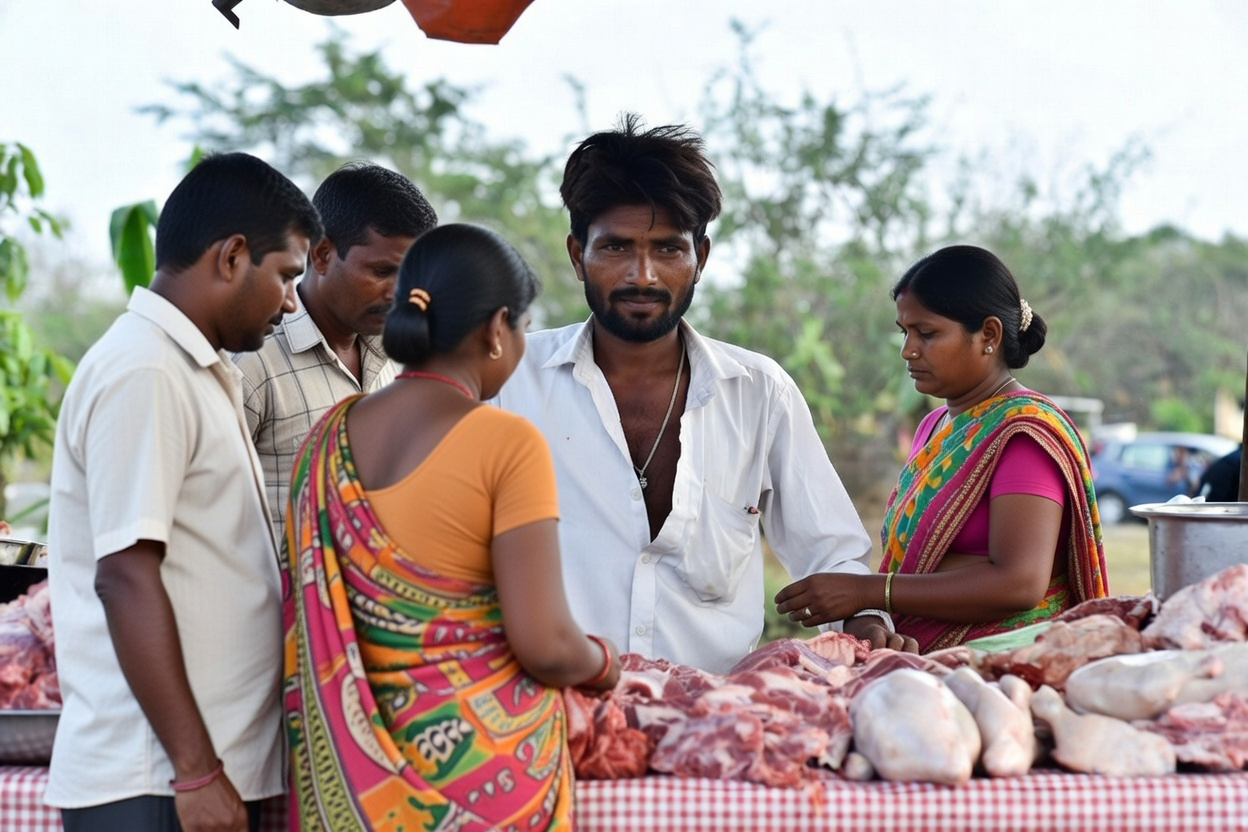
[Grok AI image for representation]
India’s beef debate is not really about faith. It is about power – who eats well, who goes hungry, who trades, who profits, and who is punished. Beneath the noisy theatre of cow protection lies a silent political economy that links rural deprivation to urban accumulation, caste privilege to communal violence, and nutritional denial to moral posturing. When beef is criminalised, it is not the cow that is being protected; it is an unequal social order that is being preserved. They did not begin by insulting a religion. They began by taking away food.
Rural India today is poorer, hungrier, and more nutritionally deprived than urban India – and this gap is not narrowing. According to NFHS-5, nearly 35–37% of rural children are stunted, compared to around 30–31% in urban areas. Anaemia affects over 57% of rural women, while rural men too suffer from chronic protein deficiency. These are not abstract statistics; they reflect daily dietary insufficiency in villages where pulses, milk, and vegetables are either unaffordable or unavailable. In this context, beef—cheap, protein-rich, iron-dense – has historically been a crucial source of nutrition for Dalits, Adivasis, landless labourers, and rural Muslims.
Yet, it is precisely this food of the poor that has been turned into a political weapon. For millions in rural India, beef is not a cultural indulgence but a nutritional necessity. One kilogram of beef provides significantly higher protein and iron than most cereals and costs far less than chicken or mutton. In tribal belts, drought-prone regions, and among migrant rural workers, beef has functioned as survival food. Criminalising it without offering affordable nutritional alternatives amounts to state-enforced malnutrition. Urban India, insulated by purchasing power and dietary diversity, rarely feels this deprivation. The city can moralise because the village starves quietly.
This rural deprivation stands in sharp contrast to the booming urban and export-oriented meat economy. India is among the world’s largest exporters of beef, with exports worth approximately USD 3.5- 4 billion annually in recent years, according to APEDA data. This meat feeds markets in Vietnam, Malaysia, Egypt, Indonesia, and the Middle East. The contradiction is staggering: beef leaves India in refrigerated containers while rural Indians are beaten for carrying it on bicycles.
Even more revealing is who controls this trade. Despite public claims of religious abstinence, a significant portion of slaughterhouses, processing units, cold chains, and export firms are owned or financed by upper-caste Hindu business interests, including communities that loudly proclaim vegetarian purity. The cow is sacred in speech, but profitable in practice. What is outsourced is not just slaughter, but stigma and risk—pushed downward onto Muslim traders, Dalit workers, and transporters.
Also Read: Muslims earn peanut; Govt, Hindus benefit most from animal slaughter in India
This brings us to the Muslim connection, which is not incidental but structural. Muslims form the backbone of India’s meat economy – as butchers, transporters, tannery workers, exporters, cleaners, loaders, and daily-wage labourers. Entire local economies in towns and villages depend on this chain. When cow vigilantism erupts, it is Muslim livelihoods that are destroyed overnight. Shops shut, transport routes collapse, credit dries up, and families are pushed into precarity. Lynching is not just physical violence; it is economic terror.
This devastation is neither accidental nor secondary. Mob violence does not merely kill bodies; it disciplines labour. It forces workers to abandon night routes, close shops, migrate under duress or accept exploitative terms. Fear becomes an organising principle of the labour market. When transporters refuse work and vendors disappear, the poorest pay first—through lost income, rising debt and deepening food insecurity. Women eat less. Children drop out of school. Illness becomes routine. Communalism thus reveals itself not as a cultural dispute but as a mechanism of economic control.
Those who bear the brunt of this violence are not difficult to identify. Dalits lose both sustenance and ancestral livelihoods already burdened by stigma. Adivasis, for whom meat consumption is integral to dietary survival, are rendered suspect within their own geographies. Muslim workers, disproportionately represented in meat processing, transport and retail, become permanent targets of raids, arrests and public humiliation. The working poor in towns and cities—street vendors, small eatery owners, daily-wage labourers—are pushed out of public space by moral policing that masquerades as law enforcement.
The violence unleashed in the name of the cow has functioned as a sustained assault on livelihoods. Lynching, intimidation, nocturnal raids, confiscation of vehicles and selective policing have shattered informal economies that support millions. Skinning cattle, tanning hides, transporting meat, working in slaughterhouses, selling cooked food—occupations passed down across generations—have been transformed into high-risk activities. What was once labour is now criminalised existence.
The urban middle class rarely understands this because it encounters beef only as an abstraction or a moral issue, never as employment. For a Muslim meat trader in a small town, beef bans mean loss of income, police harassment, extortion, and constant fear. For a Dalit worker in a slaughterhouse, it means unemployment without compensation. For a rural Muslim cattle trader, it means criminalisation of ancestral livelihood. Meanwhile, export profits continue to flow upward, shielded by corporate structures and political patronage.
This is where caste hypocrisy becomes most visible. Upper-caste elites who publicly condemn beef consumption often benefit indirectly or directly from the industry—through logistics, finance, real estate, or export facilitation. Vegetarianism becomes a marker of moral superiority, while the “impure” work is assigned to Muslims and Dalits. The social order remains intact: purity at the top, pollution at the bottom, profit everywhere.
Urban India’s complicity is not passive. The politics of cow protection has been enthusiastically consumed by sections of the urban middle class who are far removed from hunger. This class benefits from rising land values, cheap migrant labour, and globalised food systems, while applauding laws that deepen rural distress. The result is a cruel irony: urban wealth is subsidised by rural hunger, and moral nationalism becomes a cover for economic extraction.
Cow vigilantism also serves a deeper political function. It fractures rural solidarities that might otherwise unite farmers, landless workers, Dalits, Muslims, and Adivasis around shared economic distress. By turning food into a communal fault line, attention is diverted from falling farm incomes, agrarian debt, unemployment, and the collapse of public health. The cow becomes a spectacle, while hunger remains invisible.
What is at stake, then, is not religious sentiment but the right to food, work, and dignity. A society that exports beef while jailing the poor for eating it is not confused—it is deeply unjust. A state that allows mobs to police diets while claiming to fight malnutrition is not incompetent—it is ideologically driven.
If India is serious about ending hunger, it must confront the truth that nutrition cannot be governed by upper-caste sentiment. Protein does not recognise religion. Iron does not obey ideology. Food policy must be rooted in science, affordability, and access – not in manufactured outrage.
The final truth is uncomfortable but necessary: the loudest anti-beef voices often belong to those who neither rear cattle nor depend on meat for survival. They eat ideology; the poor eat whatever keeps them alive. Until this inversion is exposed, India’s rural poor—Dalits, Adivasis, and Muslims—will continue to pay the price for a morality they did not invent and an economy they do not control.
The cow, in this sense, is not sacred. It is strategic. And as long as it is used to discipline the hungry while enriching the powerful, the politics around it will remain less about faith—and more about who is allowed to live with dignity in India.
[The writer, Dr. Ranjan Solomon, has worked in social justice movements since he was 19 years of age. After an accumulated period of 58 years working with oppressed and marginalized groups locally, nationally, and internationally, he has now turned a researcher-freelance writer focussed on questions of global and local/national justice. Since the First Intifada in 1987, Ranjan Solomon has stayed in close solidarity with the Palestinian struggle for freedom from Israeli occupation, and the cruel apartheid system. He has initiated solidarity groups in India, Afro-Asia-Pacific alliance, and at the global level. Ranjan Solomon can be contacted at ranjan.speaks07@gmail.com.]
Follow ummid.com WhatsApp Channel for all the latest updates.
Select Language to Translate in Urdu, Hindi, Marathi or Arabic