IBM, Cisco join hands to build 'Networked Quantum Computers'
Tech giants IBM and Cisco have announced to build jointly a large scale network of Quantum computers
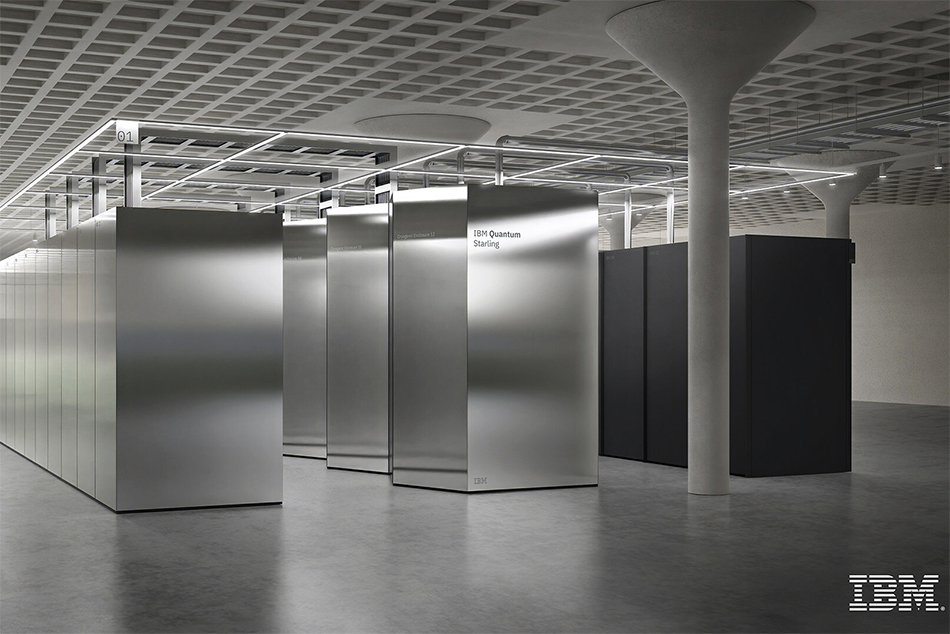
Tech giants IBM and Cisco have announced to build jointly a large scale network of Quantum computers.
Announcing to collaborate on the groundwork for networked distributed quantum computing, IBM and Cisco said the system will be launched as soon as the early 2030s.
"By combining IBM's leadership in building useful quantum computers with Cisco's quantum networking innovations, the companies plan to explore how to scale large-scale, fault-tolerant quantum computers beyond IBM's ambitious roadmap", the two said in a statement.
Additionally, the two will work to solve fundamental challenges towards quantum computing internet.
IBM and Cisco aim to demonstrate the first proof-of-concept for a network that combines individual, large-scale, fault-tolerant quantum computers within the next five years, enabling them to work together to run computations over tens to hundreds of thousands of qubits.
"This network would allow problems to be run with potentially trillions of quantum gates, the fundamental entangling operations required for transformative quantum applications such as massive optimization problems, or the design of complex materials and medicines", the tech giants said.
"Decade Long Roadmap"
Elaborating further, Jay Gambetta, Director of IBM Research and IBM Fellow, the roadmap includes plans to deliver large-scale, fault-tolerant quantum computers before the end of the decade.
"By working with Cisco to explore how to link multiple quantum computers like these together into a distributed network, we will pursue how to further scale quantum's computational power. And as we build the future of compute, our vision will push the frontiers of what quantum computers can do within a larger high-performance computing architecture", Jay said.
In his comments, Vijoy Pandey, GM/SVP at Outshift by Cisco said, "Getting quantum computing to useful scale is not just about building bigger individual machines, it is also about connecting them together,"
"IBM is building quantum computers with aggressive roadmaps for scale-up, and we are bringing quantum networking that enables scale-out. Together, we are solving this as a complete system problem, including the hardware to connect quantum computers, the software to run computations across them, and the networking intelligence that makes them work", he added.
Distributed Quantum Computing Network
IBM and Cisco intend to explore the development of quantum hardware and software that could physically link many large-scale, fault-tolerant quantum computers together to form networked distributed quantum computing.
The companies are targeting an initial proof-of-concept demonstration by the end of 2030, for which they plan to entangle qubits from multiple separate quantum computers located in distinct cryogenic environments. Doing so will require the companies to invent new connections, including microwave-optical transducers and a supporting software stack.
The Cisco vision for a quantum data center introduces an architecture for quantum networking infrastructure that could make distributed quantum computing a reality in the near future. This vision includes a complete hardware and software stack that aims to preserve fragile quantum states, distribute entanglement resources, facilitate teleportation between quantum computers, and synchronize operations with sub-nanosecond precision.
To scale beyond linking two quantum computers that are separate but physically close, IBM and Cisco are planning to explore how to transmit qubits over longer distances, such as between buildings or data centers. To achieve this, the companies will explore optical-photon and microwave-optical transducer technologies, as well as investigate how they can be incorporated into a quantum network to transfer quantum information as needed.
Linking together multiple quantum computers will require an appropriate interface. IBM plans to build a quantum networking unit (QNU) to serve as the interface to a quantum processing unit (QPU), with the explicit task of taking stationary quantum information in the QPU and converting it into "flying" quantum information through the QNU to then be further linked across potentially multiple quantum computers through a network.
Cisco's quantum network would aim to distribute the entanglements to arbitrary pairs of these QNUs on an on-demand basis to drive the quantum information transfer required for a given quantum algorithm or application. Towards this goal, Cisco is developing a high-speed software protocol framework that can continuously and dynamically reconfigure network paths so entanglements could be distributed to the QNUs when they are done with their partial computations.
Together, the companies plan to investigate how a network bridge, comprised of novel hardware and open-source software, could use Cisco quantum network nodes to link many IBM QPUs within a data center through its QNU interface. In the future, this approach could be extended to link QPUs across multiple data centers. This would scale a larger quantum network across even larger distances to form the groundwork for a future quantum computing internet.
IBM quantum computers linked by this architecture could facilitate massively computationally demanding workloads, including those that require high-performance computing resources as part of a quantum-centric supercomputing framework.
Follow ummid.com WhatsApp Channel for all the latest updates.
Select Language to Translate in Urdu, Hindi, Marathi or Arabic