Actors and Factors Responsible for Fractured Sikh Muslim Relations
The historical dynamic between the Sikh Gurus, the Mughal state, and various Hindu officials, courtiers, and kinsmen is one of the most complex and frequently oversimplified chapters of South Asian history.
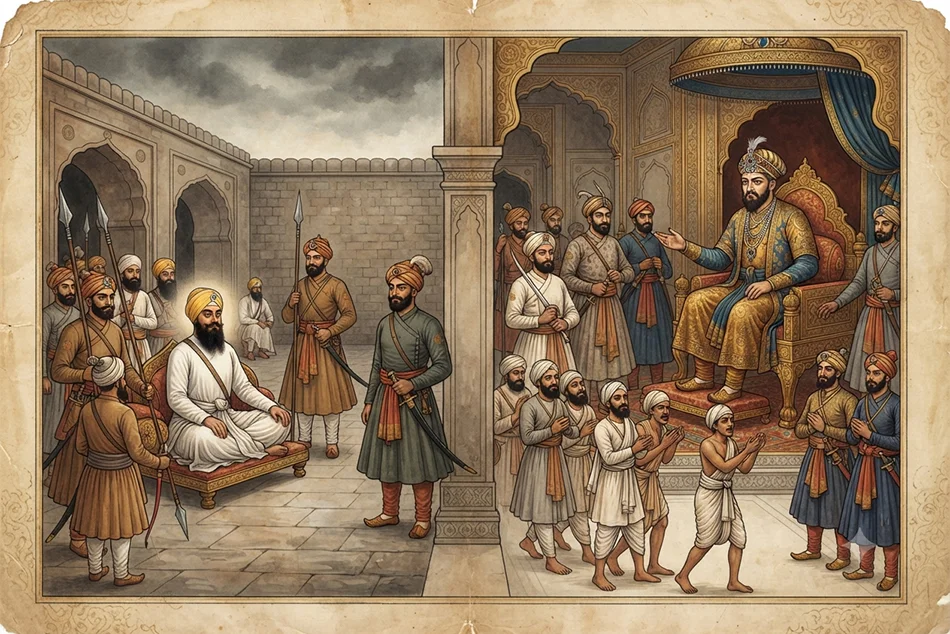
[Gemini AI Image used here for representation.]
The historical dynamic between the Sikh Gurus, the Mughal state, and various Hindu officials, courtiers, and kinsmen is one of the most complex and frequently oversimplified chapters of South Asian history. In popular memory — shaped heavily by colonial-era historiography, nineteenth-century reform movements, and modern communal politics, the narrative is often reduced to a strict binary: a monolithic Islamic empire persecuting a besieged Sikh-Hindu front.
However, an examination of primary Sikh chronicles (Janamsakhis, Gurbilas literature, Suraj Prakash, Panth Prakash) alongside Persian court histories reveals a far more intricate reality. The Sikh Gurus did not merely face external imperial hostility from emperors like Jahangir and Aurangzeb; they were simultaneously locked in existential struggles against entrenched Brahmanical orthodoxy, rival claimants within their own family, jealous hill chieftains, and high-ranking Hindu bureaucrats who weaponized the Mughal state apparatus to settle personal, caste, and sectarian scores.
To understand why figures like Prithi Chand, Chandu Shah, Gangu, Sucha Nand, and the Hill Rajas have been historically underplayed compared to the Mughal emperors - and what their actual roles were, requires examining both the historical record and the forces that shaped how that history was remembered.
1. The Historical Context: A Multi-Front Struggle
From its inception under Guru Nanak, the Sikh movement posed a radical challenge to the existing socio-religious order of northern India. By rejecting the authority of the Vedas, the caste hierarchy (varnashrama dharma), ritualism, and the intermediary role of the Brahmin priesthood, the Gurus alienated the conservative Hindu establishment long before they ever came into conflict with the Mughal throne.
Simultaneously, the Mughal Empire was not a purely theological administration operated solely by Muslim clerics. From the reign of Akbar onward, the imperial bureaucracy—particularly the revenue, finance (diwani), and intelligence departments—was heavily staffed by upper-caste Hindus, predominantly Khatris, Kayasthas, and Kashmiri Brahmins. These officials wielded immense administrative power, often acting as the local eyes, ears, and executioners of imperial policy. When the Sikh Gurus threatened their social standing, financial interests, or personal pride, these officials used their proximity to Mughal power to instigate state repression.
2. Key Antagonists Within the Non-Muslim Fold
Prithi Chand (Prithi Mal): Sectarian Sabotage from Within
The first major threat to the survival and integrity of the Sikh Panth came not from Lahore or Delhi, but from within the Guru's own household. When Guru Ram Das passed the guruship to his youngest son, Guru Arjan Dev, in 1581, his eldest son, Prithi Chand (often referred to as Prithia or Prithi Mal in traditional accounts), refused to accept the decision.
Prithi Chand’s opposition was neither passive nor brief; it was a sustained, decades-long campaign to bankrupt, delegitimize, and physically eliminate Guru Arjan Dev and his young son, Hargobind:
- Financial Strangulation: Prithi Chand positioned himself at the outskirts of Amritsar, intercepting pilgrims coming to pay homage to Guru Arjan. Claiming to be the rightful Guru, he diverted their offerings (dasvandh) to his own coffers, starving the central Sikh kitchen (langar) and the construction of the Harmandir Sahib of funds.
- Assassination Attempts on Hargobind: When Guru Arjan Dev was blessed with a son, Hargobind, Prithi Chand’s hopes of inheriting the guruship by default vanished. Sikh chronicles document multiple attempts orchestrated by Prithi Chand and his wife, Karmo, to murder the infant—first by bribing a wet nurse to poison him, then by hiring a snake charmer to release a cobra in his room, and finally by attempting to poison his food through a household servant.
- Collusion with Imperial Authorities: Failing to destroy the Guru internally, Prithi Chand allied himself with Sulhi Khan and Sulbi Khan, revenue officials of Lahore, and actively petitioned the Mughal court. He filed formal complaints accusing Guru Arjan Dev of compiling a scripture (the Adi Granth) that insulted both Islam and Hinduism, and of harboring political ambitions. While Emperor Jahangir ultimately ordered Guru Arjan Dev’s execution in 1606—citing the Guru's blessings to the rebellious Prince Khusrau in his memoirs (Tuzuk-i-Jahangiri) — Sikh tradition unequivocally records that Prithi Chand laid the groundwork for the state’s hostility.
Chandu Shah: Personal Vendetta and the Martyrdom of Guru Arjan Dev
While Jahangir issued the imperial decree, Sikh historiography places the immediate, visceral brutality of Guru Arjan Dev’s martyrdom at the feet of Chandu Shah (Chandu Lal), a wealthy Khatri banker and the Diwan (chief finance minister) of the Mughal governor of Lahore.
The conflict between Chandu Shah and the house of the Guru was rooted in caste arrogance and wounded pride:
- The Rejected Marriage Proposal: Seeking a suitable match for his daughter, Sada Kaur, Chandu Shah’s emissaries proposed an alliance with Guru Arjan Dev’s son, Hargobind. However, Chandu Shah had privately mocked the Guru’s spiritual status, remarking disparagingly that placing the Guru's family on par with his own high imperial office was like "putting the ornamental tile of a palace into a drain." When the Sikh congregation (Sangat) of Delhi informed Guru Arjan Dev of Chandu’s contempt, the Guru respected the wishes of the Sangats and declined the proposal.
- Weaponizing the State: Humiliated by the rejection, Chandu Shah became a relentless enemy. Following Akbar’s death and Jahangir’s ascension, Chandu used his influence at the imperial court to amplify accusations against Guru Arjan Dev, feeding Jahangir’s paranoia regarding the Guru’s growing influence and alleged support for Prince Khusrau.
- Custody and Torture: Once Jahangir levied a heavy fine on Guru Arjan Dev and ordered his arrest, Chandu Shah paid the fine himself or secured custody of the Guru under the pretext of extracting the money. In May 1606, Guru Arjan Dev was tortured in Lahore for days—made to sit on a red-hot iron plate, boiled in a cauldron of water, and had burning sand poured over his body. According to traditional Sikh accounts (such as Kavi Santokh Singh’s Suraj Prakash), Chandu Shah personally supervised these tortures, repeatedly demanding that the Guru accept the marriage proposal to save his life. When the Guru remained steadfast, Chandu ordered him taken to the River Ravi, where the Guru vanished into the waters.
The Hill Rajas (Pahari Rajas) of the Shivalik Hills
During the periods of Guru Hargobind, Guru Tegh Bahadur, and most intensely under Guru Gobind Singh, the primary regional adversaries of the Sikhs were not the Mughals, but the Hindu Rajput chieftains of the Shivalik Hills—most notably Raja Bhim Chand of Kahlur (Bilaspur), Raja Hari Chand of Handur, and Raja Fateh Shah of Garhwal.
- Ideological Hostility to the Khalsa: The Hill Rajas were staunch upholders of caste hierarchy and idol worship. Guru Gobind Singh’s creation of the Khalsa in 1699—which abolished caste distinctions, elevated the lower castes (Shudras) to the status of warrior-saints, and forbade idol worship—was viewed by these rulers as an existential threat to their feudal and religious authority.
- Instigating Imperial Wars: Repeatedly defeated by Guru Gobind Singh’s forces in battles such as Bhangani (1688) and Nadaun (1691), the Hill Rajas realized they could not dislodge the Guru from Anandpur Sahib on their own. Consequently, they formed a confederacy and dispatched urgent petitions to Emperor Aurangzeb (who was then campaigning in the Deccan), portraying Guru Gobind Singh as a dangerous rebel carving out an independent sovereign state in the foothills.
- The Siege of Anandpur (1704): It was the persistent lobbying and military alliance of the Hill Rajas with the Mughal governors of Sirhind (Wazir Khan) and Lahore (Zabardast Khan) that resulted in the devastating seven-month siege of Anandpur Sahib in 1704. When the besieged Sikhs finally evacuated the fortress on solemn oaths—sworn on the Quran by Mughal commanders and on the sacred cow by the Hill Rajas—both parties broke their vows immediately, ambushing the Guru’s retinue at the flooded Sarsa river.
Gangu: Betrayal of Trust and the Younger Sahibzadas
In the aftermath of the treacherous evacuation of Anandpur Sahib in December 1704, Guru Gobind Singh’s family was separated in the chaos at the Sarsa river. His aged mother, Mata Gujri, and his two youngest sons, Sahibzada Zorawar Singh (age 9) and Sahibzada Fateh Singh (age 7), found themselves alone.
They were encountered by Gangu (Gangaram), a Kashmiri Brahmin who had served as a trusted domestic cook and attendant in Guru Gobind Singh’s household for over two decades. Gangu offered to shelter them at his ancestral village, Saheri (near Morinda).
- Greed and Treachery: Mata Gujri carried a saddlebag containing gold coins (mohars) for emergencies. During the night, Gangu stole the bag. When Mata Gujri politely inquired about it the next morning, Gangu feigned outrage at being accused of theft—despite being a Brahmin—and used his contrived indignation as a pretext to betray them.
- Handing Over the Children to Wazir Khan: Driven by the desire to keep the stolen gold and collect the hefty imperial bounty placed on the Guru’s family, Gangu reported their presence to the local officials of Morinda, Jani Khan and Mani Khan, who arrested the elderly grandmother and the two young boys and handed them over to Nawab Wazir Khan, the Mughal governor of Sirhind. Without Gangu’s betrayal, the younger Sahibzadas would never have fallen into Wazir Khan’s hands.
Sucha Nand: Architect of the Execution at Sirhind
If Gangu delivered the young princes to Sirhind, it was Sucha Nand, a Hindu Khatri and the Diwan (chief minister) of Nawab Wazir Khan’s court, who ensured they would not leave alive.
When Sahibzada Zorawar Singh and Sahibzada Fateh Singh were brought before Wazir Khan’s court in December 1704, they refused to bow or renounce their faith, responding instead with the Khalsa greeting (Waheguru Ji Ka Khalsa, Waheguru Ji Ki Fateh). Remarkably, historical records show that Nawab Sher Muhammad Khan of Malerkotla — a Muslim Pathan ally of Wazir Khan—vehemently opposed executing the children, arguing that innocent boys should not be punished for their father’s opposition to the empire ("Haah da Naara"). Wazir Khan himself hesitated, momentarily swayed by Sher Muhammad Khan’s plea and the children’s tender age.
At this decisive moment, Sucha Nand intervened to seal their fate:
- The Viper Metaphor: Addressing Wazir Khan, Sucha Nand warned against showing mercy, famously invoking a proverb: "To kill a viper and spare its young is not wisdom." He argued that if released, these boys would grow up to become far more formidable rebels than their father, Guru Gobind Singh.
- Pressuring the Qazi: When the court Qazi initially stated that Islamic law (Sharia) did not permit the execution of innocent minors, Sucha Nand relentlessly pressured the court, framing the boys as active combatants and enemies of the state who had already defied imperial authority.
- The Execution: Yielding to Sucha Nand’s counsel, Wazir Khan ordered the two children to be bricked alive inside a wall (Neehan) on December 26, 1704. When the masonry collapsed before suffocating them, their throats were slit. Mata Gujri passed away in the cold tower (Thanda Burj) upon hearing the news.
3. Why Have the Mughals Borne the Brunt of Historical Blame?
Given the decisive, documented culpability of these Hindu actors in Sikh history, a central historiographical question emerges: Why do Jahangir and Aurangzeb occupy the position of arch-villains in popular memory, while figures like Chandu Shah, Sucha Nand, Gangu, and the Hill Rajas are often treated as secondary footnotes or forgotten altogether?
Several structural, political, and cultural factors explain this asymmetry:
Factor Impact on Historical Memory
- The Sovereign Principle of Accountability In pre-modern statecraft, ultimate moral and political responsibility rests with the sovereign. Jahangir and Aurangzeb held the supreme authority of the empire; their officials acted in their name and under their seal. A subordinate’s malice could only become fatal because the emperor possessed and authorized the machinery of execution.
- Colonial Historiography ("Divide and Rule") 19th-century British historians (such as James Mill, Henry Elliot, and later popularizers) deliberately framed Indian history as a perpetual civilizational war between "tyrannical Muslim invaders" and "oppressed native Hindus/Sikhs." Highlighting Hindu bureaucrats as the primary instigators of Sikh martyrdom undermined the colonial narrative that British rule had rescued Hindus and Sikhs from Muslim tyranny.
- 19th & 20th-Century Communal Consolidation During the Singh Sabha movement, the Arya Samaj debates, and particularly the trauma of the 1947 Partition of Punjab, community boundaries hardened along religious lines. In the aftermath of Partition violence between Muslims and Sikhs/Hindus, popular retellings of history naturally gravitated toward emphasizing Mughal/Muslim atrocities while downplaying conflicts between Hindus and Sikhs.
- The "Protector of Dharma" Narrative Guru Tegh Bahadur’s supreme sacrifice in 1675 to protect the religious freedom of Kashmiri Brahmins against Aurangzeb’s forced conversions became the cornerstone of Sikh-Hindu solidarity. Emphasizing that connection made it culturally awkward in modern times to simultaneously highlight how Brahmins (like Gangu) and Khatris (like Chandu and Sucha Nand) betrayed the Gurus' own family.
- Visibility of Imperial Monuments vs. Bureaucrats Emperors leave behind vast empires, chronicles, and dynasties; bureaucrats leave behind administrative records. In folk ballads (Dhadhi Vaars), personifying evil in the supreme monarch of Delhi provides a clearer, grander dramatic arc than dissecting the bureaucratic intrigues of a provincial Diwan.
4. Nuance in Traditional Sikh Historiography
Crucially, traditional Sikh memory itself never absolved these figures, even if modern political discourse has obscured them. Within Sikh oral tradition, ardas (daily prayer), and classical texts, their names carry permanent infamy:
- Linguistic Stigma: In Punjabi vernacular influenced by Sikh history, the name "Gangu" became synonymous with a treacherous household traitor, "Chandu" became a byword for petty, vindictive cruelty, and "Sucha Nand" (ironically meaning "pure bliss") was sarcastically inverted by Sikhs to "Jhoota Nand" (false bliss).
- Moral vs. Communal Framing: The Sikh Gurus and early Sikh chroniclers did not view their struggle through a modern communal lens of "Hindus vs. Muslims." Instead, they categorized human beings strictly by moral conduct: Gurmukh (one oriented toward truth and justice) versus Manmukh (one driven by ego, greed, and falsehood).
- Reciprocity of Allies Across Faiths: Just as Sikh history remembers Hindu traitors like Gangu and Sucha Nand, it equally honors devoted Hindu disciples like Bhai Mati Das, Bhai Sati Das, and Bhai Dayala (who were martyred alongside Guru Tegh Bahadur), Todar Mal (a wealthy Hindu merchant of Sirhind who bought land for the cremation of the younger Sahibzadas by covering the ground with gold coins standing upright), and Moti Ram Mehra (a Hindu servant who risked his life to smuggle warm milk to the imprisoned Sahibzadas in the Thanda Burj). Conversely, alongside Mughal tyrants like Wazir Khan, Sikh tradition reveres Muslim figures like Pir Buddhu Shah (who fought for Guru Gobind Singh at Bhangani, losing two sons), Nabi Khan and Ghani Khan (who rescued the Guru after Chamkaur), and Nawab Sher Muhammad Khan of Malerkotla.
5. Summary of the Historical Reality
The persecution of the Sikh Gurus was not a simple clash of religions; it was a collision between a revolutionary egalitarian movement and an entrenched nexus of imperial power, feudal privilege, and caste orthodoxy. Jahangir and Aurangzeb provided the sovereign sanction and military might of the Mughal state, making their historical culpability undeniable.
Yet, without the ideological hostility of the Shivalik Hill Rajas, the familial treachery of Prithi Chand, the wounded caste pride of Chandu Shah, the greed of Gangu, and the cold bureaucratic malice of Sucha Nand, the tragic milestones of Sikh martyrdom would have unfolded very differently. Recognizing these figures does not diminish the responsibility of the Mughal emperors—rather, it restores historical accuracy by showing that tyranny in pre-modern India was a collaborative enterprise across religious lines, just as resistance to it was shared by people of conscience from every faith.
[Dr. Syed Inam ur Rahman (Ghayur) is Hyderabad based writer.]
Follow ummid.com WhatsApp Channel for all the latest updates.
Select Language to Translate in Urdu, Hindi, Marathi or Arabic