Analysing The Risks Involved in Expansion of AIMIM, AIUDF
Under the First Past the Post system, parties such as AIMIM and AIUDF offer no credible pathway to reducing Muslim marginalisation at the national or state level

The partition of 1947 divided South Asian Muslims into three political spaces. This outcome was not the failure of one party alone; it reflected a collective breakdown involving colonial strategy, the Indian National Congress, and the Muslim League. The British exit ensured territorial division without political stability, leaving behind enduring regional tensions.
In West and East Pakistan, and later in Bangladesh after 1971, religious minorities, particularly Hindus and other non-Muslims, faced sustained marginalisation.
In India, Muslims who chose to stay were not provided political reservation, though constitutional guarantees were extended for religious, cultural, and educational rights. These safeguards were important but structurally limited, as they did not translate into assured political power. Since 2014, the vulnerability of this arrangement has become increasingly evident.
For much of independent India’s history, Muslims aligned with the Congress and other secular parties. This alignment was not rooted in unconditional loyalty, but in political realism. These parties functioned as a check on majoritarian consolidation, even though communal violence persisted and Muslim socio-economic deprivation remained unresolved.
A significant political realignment followed the implementation of the Mandal Commission under Prime Minister V. P. Singh, which extended 27 per cent reservation to Other Backward Classes. This reform enabled the political rise of OBC leadership and regional parties, while simultaneously alienating sections of upper-caste Hindus.
Over time, this resentment was consolidated by the Bharatiya Janata Party, which has since emerged as the most resource-rich, organisationally disciplined, and institutionally influential political force in India.
In the current political discourse, secular parties are routinely portrayed as “Muslim parties” a claim that is factually incorrect but electorally effective.
Also Read: AIMIM Rise Meaningless If Doesn't Lead to Muslim Empowerment
At the same time, the BJP has successfully incorporated OBC, SC, and ST groups through welfare delivery and symbolic inclusion, while offering little substantive political representation or policy assurance to Muslims.
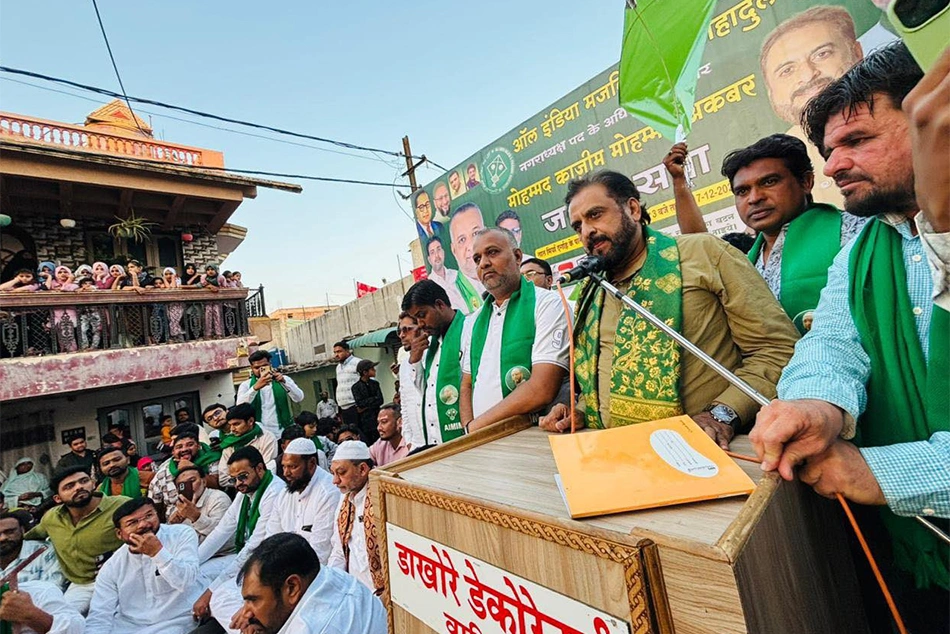
It is within this context that the expansion of AIMIM must be examined. The party’s leadership, particularly Asaduddin Owaisi, argues that Muslims must secure legislative representation in proportion to their population.
Normatively, this claim appears just. Institutionally, it is untenable under India’s First Past the Post electoral system. FPTP does not translate vote share into seat share; it rewards consolidated majorities and penalises dispersed minorities.
The continued assertion that Muslims can achieve population-proportionate representation through identity-based parties without proportional representation reforms amounts to a serious misreading of electoral reality.
Under FPTP, such parties neither form governments nor substantially enhance Muslim legislative presence. Instead, they fragment minority votes, indirectly strengthening the dominant communal party.
More critically, this strategy has increasingly relied on emotional mobilization rather than structural analysis. Political frustration and social insecurity are converted into electoral symbolism, while the predictable consequence reduced winnability of Muslim candidates from secular parties is ignored. This is not political empowerment; it is political misdirection.
Also Read: 3 Political Choices Muslims have in Modi's India
The personal success of a limited number of leaders cannot be equated with collective advancement. Electoral victories concentrated within a few constituencies do not offset the broader decline in Muslim representation across assemblies. On the contrary, the repeated entry of Muslim-identified parties into closely contested seats often results in Muslim vote division and the victory of majoritarian candidates.
Historical context remains essential. Without the presence of the Congress and allied secular forces during Partition, the fate of Indian Muslims could have been far more precarious. Despite persistent hardships, Muslims in India today constitute the world’s third-largest Muslim population, living within a constitutional democracy.
Political rhetoric that dismisses secular parties entirely, or frames them as the principal obstacle to Muslim dignity, obscures this reality. Symbolic defiance and rhetorical absolutism do not substitute for viable political strategy. Even globally, Muslim-majority states despite facing coercion, intervention, and humiliation, continue pragmatic engagement with dominant powers. Political realism, however uncomfortable, remains unavoidable.
Under the First Past the Post system, parties such as AIMIM and AIUDF offer no credible pathway to reducing Muslim marginalisation at the national or state level. Without electoral system reform or durable coalition politics, their expansion risks deepening political isolation rather than correcting it. For Indian Muslims, the pressing need is not emotional assertion, but strategic participation grounded in institutional realities.
Also Read: Pushing Muslim Political Consciousness Back to Pre-Partition Mindset
A further concern is the instrumental use of Muslim suffering as political capital by sections of Muslim leadership itself. Leaders such as Asaduddin Owaisi, along with figures including Akbaruddin Owaisi, Imtiaz Jaleel, and Akhtarul Iman, increasingly frame Muslim political marginalisation as evidence of betrayal by secular parties rather than a consequence of India’s electoral structure.
This narrative selectively amplifies grievance while remaining silent on the predictable electoral effects of vote fragmentation under the First Past the Post system. While a limited number of leaders consolidate, secure constituencies and political careers, the broader Muslim electorate bears the cost through declining winnability of Muslim candidates across competitive seats.
The repeated invocation of population-proportionate representation, without advocating proportional representation reforms, transforms legitimate Muslim anxieties into emotive mobilisation rather than actionable political strategy. In effect, collective vulnerability is converted into personalised electoral leverage, with long-term consequences for Muslim representation that remain unaddressed.
[The writer, Amir Hussain, is Academic Counsellor (Social Work & Political Science) IGNOU]
Follow ummid.com WhatsApp Channel for all the latest updates.
Select Language to Translate in Urdu, Hindi, Marathi or Arabic