Gen Z Triumphs in Nepal, Falters in Bangladesh
During the last six months, there have been two political movements and subsequent elections in India’s immediate neighbourhood - Bangladesh and Nepal, which might have an impact on India’s regional aspirations and impact.

During the last six months, there have been two political movements and subsequent elections in India’s immediate neighbourhood, which might have an impact on India’s regional aspirations and impact.
These two movement and elections happened in Bangladesh and Nepal. Both were led by the young voters of the two countries, anxious for a change in the political leadership of their countries. But the results in both have been different. Let’s analyse the reasons for the same.
Nepal’s political landscape appears poised for a major transformation as Balendra Shah, widely known as Balen Shah, emerged as the sole contender for the country’s prime ministership following the latest general elections. The 35-year-old Kathmandu mayor and former rapper represents a new generation of leadership challenging the dominance of traditional political elites. His rise has energised young voters and highlighted growing demand for political reform and transparent governance in the Himalayan nation.
In Nepal, the resultsare exactly the opposite of what happened in Bangldesh, where, despite a student-led revolution toppling the incumbent government, the principal opposition party in the previous regime returned to power in the elections that followed. The newly formed student-led' party, the National Citizen Party, failed to make an impact.
Election Trends and Political Momentum
Preliminary trends from Nepal’s recent general elections showed a strong performance by the Rastriya Swatantra Party (RSP). Shah himself won in the Jhapa-5 constituency against veteran leader and former prime minister KP Sharma Oli of the Communist Party of Nepal (UML).
If the trend continues, Shah could become one of the youngest prime ministers in Nepal’s history, marking a dramatic shift from a political establishment largely dominated by leaders in their 60s and 70s.
Shah’s prime ministerial campaign began with a culturally symbolic speech in Janakpur, the capital of Madhesh Province and traditionally regarded as the birthplace of Goddess Sita. He opened his address with “Sarvapratham, Mata Janaki kepranaam,” and delivered the speech in Maithili, one of Nepal’s widely spoken languages.
The choice of location and language was significant. Few national leaders in Nepal have launched a major political campaign in Maithili, which is widely spoken across the Madhesh region and India’s Mithila belt. The move signalled outreach to Madhesi communities, which have historically sought greater political representation.
From Rapper to a Reformist Politician
Before entering public life, Shah gained popularity as a rapper who used hip-hop music to raise awareness about corruption, governance failures and social inequality. His music resonated strongly with urban youth.
In 2022, Shah shocked Nepal’s political establishment by winning the Kathmandu mayoral election as an independent candidate, defeating nominees from major parties. During his tenure, he focused on addressing the capital’s waste management crisis, removing illegal encroachments on public land, improving traffic management, restoring heritage sites and developing public parks.
Born on April 27, 1990, in Naradevi, Kathmandu, Shah’s family traces its roots to Mahottari district in Madhesh Province. He is associated with the Madhesi community, which forms nearly one-third of Nepal’s population and shares strong cultural links with neighbouring regions of India.
Shah resigned as Kathmandu mayor in January 2026 to contest the national elections under the Rastriya Swatantra Party after reaching an agreement with party chairman Rabi Lamichhane. His campaign has emphasised youth empowerment, anti-corruption reforms, transparent governance and strengthening Nepal’s federal system—issues that have resonated strongly with Gen Z and millennial voters seeking political change.
Similar Goals, Different Outcomes
The protests in Bangladesh and Nepal, countries that are separated by the narrow Siliguri Corridor, had the same goal - replacing the existing system.
While the uprising in Bangladesh was set in motion by forces like the Jamaat-backed ChhatraShibir, with a more politically stated goal of removing the incumbent from power, the one in Nepal was more organic, with a focus on overthrowing the system. This allowed leaders like Balen Shah, 35, to emerge as genuine alternatives to the existing political parties.
The students' movement in Bangladesh, on the other hand, could not create a leader who was acceptable to the people of the country. The movement was more focused on removing Prime Minister Sheikh Hasina, and could not offer an alternative to the people.
The Tarique Rahman Factor
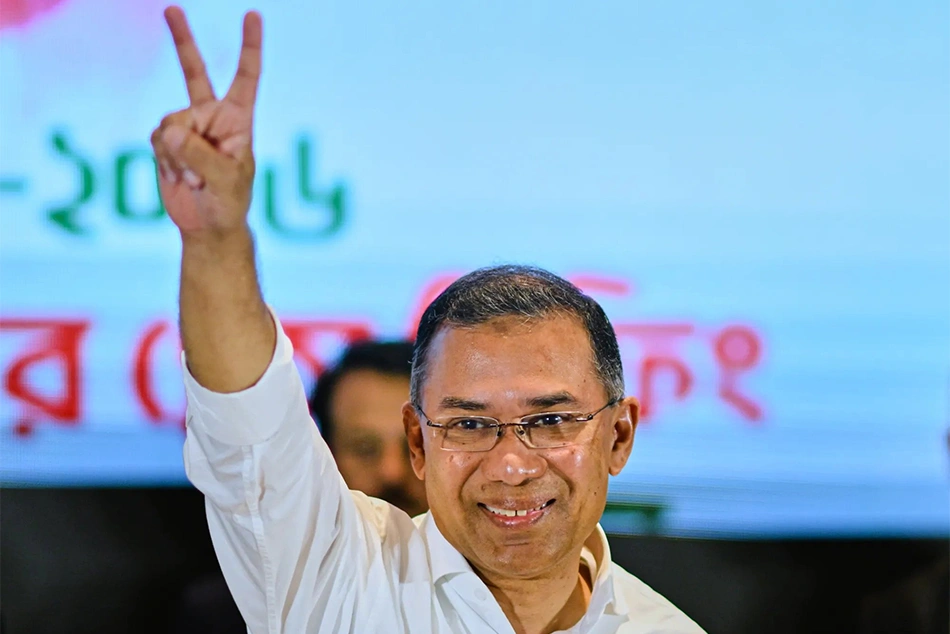
With the toppling of the Hasina government in Bangladesh, former prime minister Khaleda Zia's son Tarique Rahman emerged as the only credible alternative, even though he was a product of the existing political system. Having been in political exile and out of the country for 17 years, Tarique Rahman offered fresh ideas, a new approach and, more importantly, a clear vision of Bangladesh’s future.
Rahman's "I have a plan" speech set the ball rolling for his party, the Bangladesh Nationalist Party (BNP), to talk about what it intended to do for citizens.
This approach worked, making him appear to be a more pragmatic choice than the students' groups who had joined forces with the Bangladesh Jamaat-e-Islami, a fringe player in electoral politics. Rahman's inclusive politics and outreach to minorities also played a role in his popularity.
Balen's Popularity
On the other hand, Balendra Shah emerged as a frontrunner for the prime minister's post after Gen Z protests rocked Nepal in September last year, triggered by a social media ban that was later rolled back.
Shah originally became famous as a rapper under the name "Balen", and his music, which critiqued social ills and political corruption, resonated with the youth of the country. He went on to become the Mayor of Kathmandu and when he was asked during the protests whether he would take up the post of prime minister, he refused.
In contrast, student leaders in Bangladesh were embroiled in several controversies soon after the overthrow of the Hasina regime and some also took up positions in the interim government. To many people, they were seen as pursuing power rather than change.
The alliance of the students' party, the NCP, with the Jamaat-e-Islami, known for its anti-minority stance, also alienated many. Balen Shah, on the other hand, was seen as running a campaign that embraced minorities, especially Madhesis, making him appear more inclusive.
Shah's term as the Kathmandu Mayor also helped him, especially since he focused on issues that affected ordinary people, including improving traffic management, clearing encroachments on public land, and resolving long-standing garbage disposal problems.
During his campaign, the 35-year-old drew large crowds and was seen as an undeclared leader of young voters. He also helped form the interim government, with former Chief Justice Sushila Karki as its head, to oversee the vote.
The student leaders in Bangladesh, on the other hand, harmed their image of fighting for a new system by tying up with the Jamaat, which was an established political force.
This also gave people the impression that they were willing to sacrifice the aspirations of students to ensure the victory of the party's leaders.
[The writer, Asad Mirza, is Delhi based Journalist and Author.]
Follow ummid.com WhatsApp Channel for all the latest updates.
Select Language to Translate in Urdu, Hindi, Marathi or Arabic