Backgrounder: Nepal Elections 2026
Nepal will go to the polls on March 05, 2026 to elect a new government when nearly 19 million people will take part in the ballot for Nepal's House of Representatives
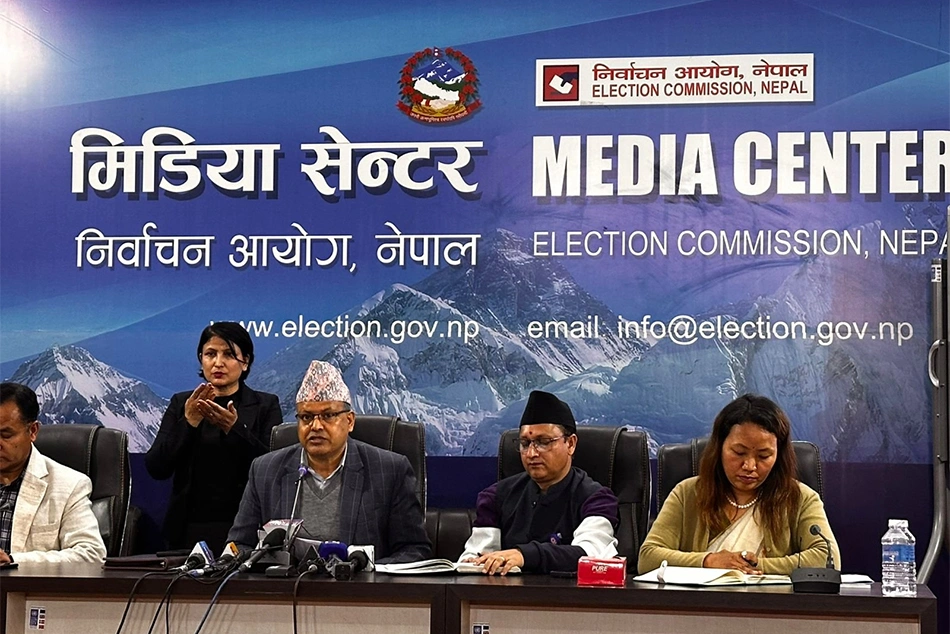
Nepal will go to the polls on March 05, 2026 to elect a new government. Nearly 19 million people will take part in the ballot for Nepal's House of Representatives. The general election will be the first the country has held since the youth-led anti-corruption protests toppled the government in September 2025. The republic has since been governed by an interim government led by former chief justice Sushila Karki, which promised to hold fresh elections and hand over power within six months.
India’s neighbour Nepal will hold its 9th parliamentary election since the first one held in 1959. Nepal has what is called a mixed electoral system which was introduced in its 2015 constitution.
There are several political parties and politicians who are being closely watched. Balendra Shah, the 35-year-old former mayor of Nepal's capital Kathmandu, is one of them. Better known as Balen, the former rapper is taking on the country's former prime minister KP Sharma Oli who, resigned last September amid mounting public anger at long-entrenched corruption and social inequality in the Himalayan republic.
Most political parties have put particular focus on issues such as better governance, fighting corruption and reducing employment in their manifestos, which is being widely seen as a nod to the frustrations that led to the toppling of the previous government.
The campaign is heavily focused on the demands of the "Gen Z movement", focussing on Accountability: Investigating assets of public officials and ending endemic corruption, Employment: Addressing the mass exodus of youth seeking work abroad by promising job creation, and Structural Reform: Proposals include directly elected executives, term limits for Prime Ministers, and decentralisation of power.
The main political parties participating in these elections are:
Nepali Congress
The party is fighting 2026 elections under the leadership of Gagan Thapa. The party's campaign focused on the new generation taking over the leadership of the party and their image as a "renewed" party.
The party's manifesto called for structural reform cantered on good governance, administrative efficiency, and strict term limits. It proposed a one-term limit for the President, two terms for the prime minister and chief ministers, three for ministers, and a single term for party list MPs.
CPN (UML)
The party held its 11th general convention on 18 December 2025 and re-elected K. P. Sharma Oli as party’s chairman, subsequently Oli was also declared as the party’s candidate for the prime minister’s post.
The party's manifesto promised a welfare system with comprehensive social security nets.
Nepali Communist Party
The party was formed with the merger of CPN (Maoist Centre), CPN (Unified Socialist) and eight other left-wing groups.
The party unveiled its manifesto on 10 February, which focused on good governance, employment creation, social welfare, and institutional reform.
Rastriya Swatantra Party
The party signed an agreement to bring in independent Kathmandu mayor Balen Shah, who in 2025 led the Gen Z protests, into the party and declared him as the candidate for prime minister from the party.
The party's manifesto advocates for constitutional amendments and institutional reforms aimed at streamlining the bureaucracy.
The party proposed a transition to a directly elected executive and a fully proportional parliament, alongside separation of powers that would prevent legislators from serving as cabinet members.
Rastriya Prajatantra Party
The party's manifesto calls for a return to a constitutional monarchy, restoration of a Sanatan Hindu state with religious liberty, scrapping the federal system in favour of a two-tiered governance structure consisting of a central government and strong, non-partisan local governments.
People's Socialist Party Nepal
Loktantrik Samajwadi Party - Nepal, TeraiMadeshLoktantrik Party and Janata Pragatisheel Party merged with the party ahead of the nomination deadline. The party released a 27-point manifesto on 26 January 2026 that focused on strengthening the federal structure.
The party advocated for implementing a "10+1" federal model based on the 2012 High-Level State Restructuring Commission's report to ensure ethnic identity. The manifesto called for constitutional amendments incorporating demand from the Madhesh and Janajati movements, as well as the 2025 Gen Z protests.
Pragatisheel Loktantrik Party
The party was formed by leaders of CPN (Maoist Centre) that disagreed with the formation of Nepali Communist Party along with Nepal Socialist Party (Naya Shakti) led by former prime minister Baburam Bhattarai and former chief whip of Rastriya Swatantra Party, Santosh Pariyar.
The party's manifesto calls for a transition to a directly elected presidential system, direct elections for provincial heads and a fully proportional electoral system. The party proposed limiting the federal parliament to legislative duties and forming a cabinet chosen by the executive head.
Ujyaalo Nepal Party
The party was formed after the elections were announced. On 15 February 2026, the party released its election manifesto, which aims for a "Development Decade".
The party proposed a significant reduction in the downsizing administration, advocating for decreasing federal legislators to 201 and provincial legislators to 330, alongside directly elected chief ministers and non-partisan local elections.
Nepal Electoral System
In Nepal, the electoral system follows a First Past The Post (FPTP) winner, meaning whoever wins the most votes wins the seat.The second is known as Proportional Representation (PR), which considers the proportion of votes cast for a political party.A total of 165 seats will be filled via the FPTP system, while the remaining 110 seats will be elected through PR.
The idea of having both systems was to ensure inclusion as well as proportional representation across society. The system makes it difficult for one party to win outright so whoever comes top in the election will most likely need to govern in a coalition.
This election has important geopolitical ramifications too.Neighbouring India, which has historically had an outsized role in Nepal's political history, is watching closely. It has had a fractious relationship with former prime minister KP Sharma Oli in the past.
This is primarily because it sees Oli as someone who has actively pursued a closer relationship with China, India's rival, during his several terms as prime minister. The US has also been playing a role in this election and has been more aligned with India in terms of its strategic objectives.
China influence in Nepal
China has a major influence in Nepal and will be watching closely, as it will be hoping that any future government is supportive towards its interests in the country, including the Belt and Road Initiative (BRI).
Nepal is integrated with cross-border infrastructure in both directions: power lines from hydropower dams feed electricity to India, while China connects through its Belt and Road Initiative over the Himalayas via Tibet, and makes investments in airports and railways.
For nearly two decades, Nepal's political landscape was dominated by veteran leaders -- many of them former Maoist insurgents -- who took turns in power since the end of a 10-year civil war in 2006.
Last September's unrest erupted as youth protests against a brief social media ban, but was fuelled by far wider anger at economic stagnation and corruption.
Whoever prevails will become Nepal's 16th Prime Minister in less than two decades, underscoring the recurring political instability that has marked the Himalayan nation since the monarchy was abolished in 2008.
[The writer, Asad Mirza, is Delhi based Journalist and Author.]
Follow ummid.com WhatsApp Channel for all the latest updates.
Select Language to Translate in Urdu, Hindi, Marathi or Arabic