India and West Asia Crisis: Managing Interdependence in Volatile Region
West Asia will not stabilise on India's timeline. The shocks will keep coming. The only real question is whether the right systems — and the right clarity — are already in place when they do.
India's response to the killing of Iran's Supreme Leader Ali Khamenei was deliberate and calibrated. New Delhi called for restraint and urged all sides to avoid escalation. Prime Minister Modi spoke with Netanyahu and UAE leadership. The government chose its words carefully — and its silences even more so. In a region where every statement is read as alignment, that calculation is as much a policy as any declaration.
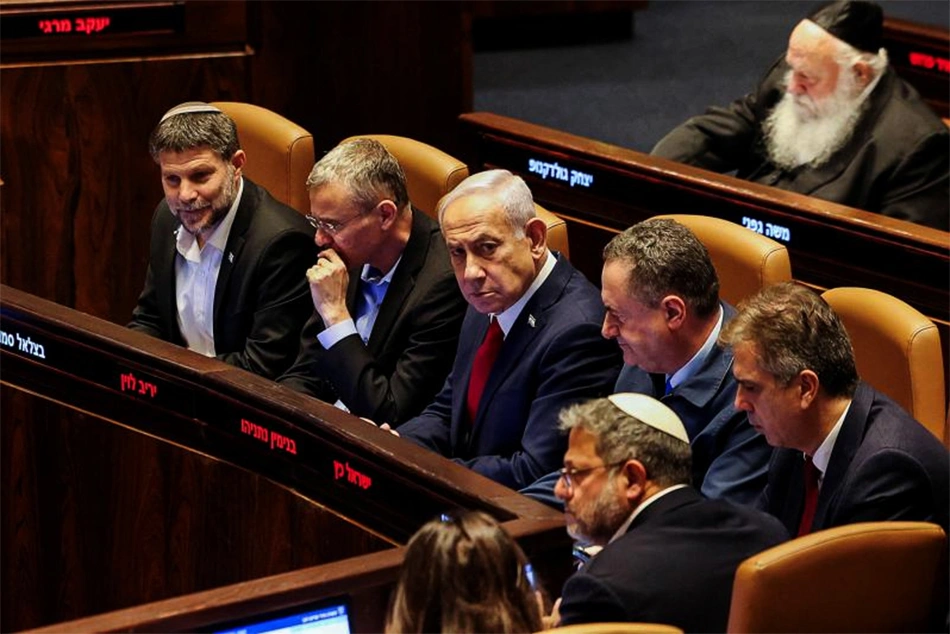
The timing added a layer of complexity that was difficult to ignore. Modi's state visit to Israel had concluded barely 48 hours before the strikes. In New Delhi, the opposition was quick to raise questions. Congress Parliamentary Party chairperson Sonia Gandhi argued that India's response raised serious doubts about the direction of its foreign policy — and questioned whether the visit's timing reflected a shift in India's carefully maintained neutrality. The government dismissed the criticism as partisan. But the question itself — about where India stands, and what its position signals to the region — is one this crisis will keep asking.
For India, the implications are not ideological. They are structural. As Syed Akbaruddin, former permanent representative of India to the UN, put it in a recent interview — "for India, the Gulf is not a distant theater, it's part of our proximate neighborhood. It is not a foreign policy file only. It is an economic and human security reality."
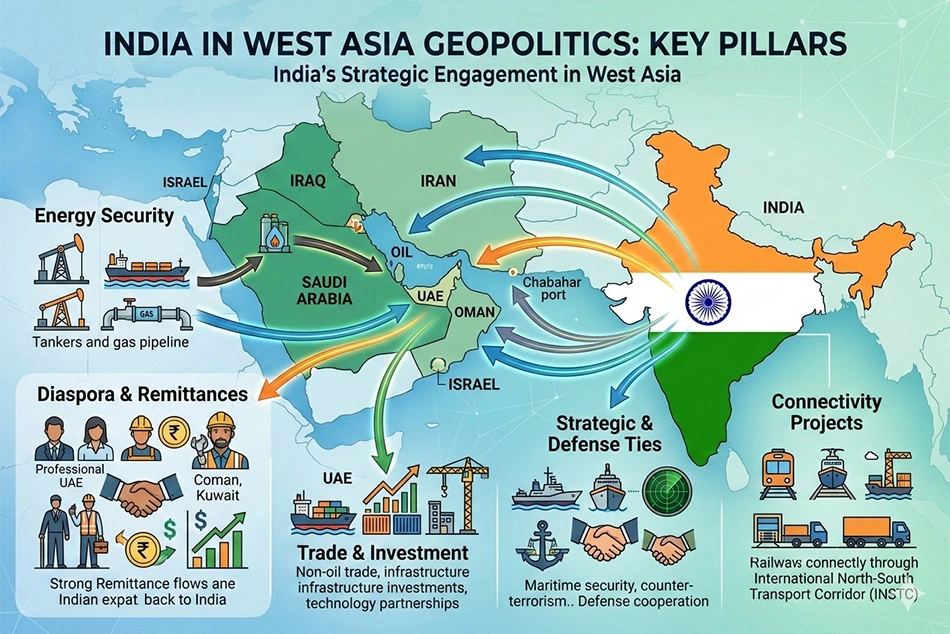
India is deeply embedded in West Asia, demographically, economically, and strategically. Its energy flows through it. Its connectivity ambitions run across it. When the region destabilizes, India does not watch from a distance. It absorbs the shock.
India Diaspora and Remittance Engine
More than nine million Indians live and work across West Asia, the majority concentrated in Gulf economies. This expatriate population forms one of the largest overseas communities in the world. A smaller but significant cohort of Indian students is also enrolled in Iranian universities, mostly in medicine, adding an educational dimension to India’s civilian presence in the region.
India is also the world’s largest recipient of remittances, receiving approximately $135 billion in financial year 2024–25, according to Reserve Bank of India data. A significant portion originates from Gulf Cooperation Council (GCC) countries — particularly the United Arab Emirates, Saudi Arabia, Kuwait, Qatar, Oman, and Bahrain — with roughly one-third to nearly 40 percent of India’s total remittance inflows originating from the Gulf region.
These flows sustain household consumption, housing construction, education spending, and small enterprise formation across states such as Kerala, Telangana, Uttar Pradesh, Bihar, and Jammu and Kashmir. They also contribute materially to India’s foreign exchange stability and current account balance.
In prolonged instability, the primary risk is not necessarily immediate evacuation but economic compression in Gulf labor markets. Hiring freezes, contract terminations, delayed wage payments, reduced remittance frequency, and currency disruptions could gradually weaken these financial flows. For students in Iran, instability carries a more immediate risk — disrupted academic calendars, safety concerns, and the logistical difficulty of emergency repatriation.
A sustained slowdown in remittance inflows would ripple through remittance-dependent districts and dampen domestic demand. Safeguarding citizens abroad therefore carries both humanitarian and economic importance.
Energy Exposure: The Direct Shock
India's energy security remains closely tied to the stability of West Asia. The country imports approximately 87–89 percent of its crude oil, making it one of the most import-dependent major economies in the world. As Syed Akbaruddin noted in a recent interview, "India's energy flows — oil, LNG (liquefied natural gas), LPG (liquefied petroleum gas), aviation fuel — come from the Gulf in a significant measure, so any increase in price will have an impact on our budget and bottom lines."
The Middle East remains a critical supplier, with Iraq, Saudi Arabia, the United Arab Emirates, and Kuwait among India's largest sources of crude. However, the sourcing picture has shifted considerably since 2022 — Russia emerged as India's single largest crude supplier, accounting for roughly 36 percent of imports in 2024–25. That arrangement faced external pressure when, in February 2026, President Trump claimed India had agreed to stop importing Russian crude — though India never officially confirmed any such commitment. India's Ministry of External Affairs maintained that energy security for 1.4 billion Indians remains the government's supreme priority, and that all sourcing decisions would be guided by commercial merit and market conditions.
That pressure has now run into an awkward reality. With the Strait of Hormuz effectively disrupted since late February, Washington was forced to reverse course. On March 5, the US Treasury issued a 30-day waiver allowing Indian refiners to continue purchasing Russian crude already at sea — covering cargoes loaded before March 5 and expiring April 4. It is temporary relief, not a policy reversal. Washington still expects India to pivot toward American supplies once the crisis stabilises. But the pressure campaign has paused — because the crisis it helped engineer made it untenable.
Speaking at the Raisina Dialogue in New Delhi on March 4, 2026, US Deputy Secretary of State Christopher Landau said Washington would work closely with India to ensure its energy requirements are met in both the short and long term. The offer signals Washington's intent to position American energy supplies as a long-term alternative — both to Russian crude and to disrupted Gulf flows — placing India at the intersection of competing energy partnerships.
Even without a formal closure of the Strait of Hormuz, geopolitical tension sustains elevated risk premiums and pushes global oil prices upward. For India, a sustained ten to fifteen dollar increase in crude prices carries significant macroeconomic consequences — expanding the import bill, placing pressure on the rupee, fuelling inflation in transport and manufacturing, and complicating fiscal management.
Strategic petroleum reserves offer temporary cushioning. But with Russian supply on a 30-day clock, Gulf routes disrupted, and Washington's long-term expectations unchanged, New Delhi faces a sourcing dilemma that is no longer purely commercial. Stability in the Gulf remains central to India's energy security architecture — but the architecture itself is now under negotiation.
Chabahar: Strategic Depth Under Uncertainty
India’s investment in Chabahar Port in Iran represents more than a commercial infrastructure project. It is a strategic gateway designed to provide India with access to Afghanistan and Central Asia while bypassing Pakistan. For New Delhi, Chabahar has long been viewed as a cornerstone of its continental connectivity strategy.
The project was already navigating turbulence before the current crisis. The Trump administration moved to place Chabahar back under sanctions as part of its maximum pressure policy on Iran, revoking the waiver that had protected India’s operations. IPGL’s government directors resigned from the board. India secured a six-month exemption — but that window is narrow and the pressure has not eased.
Political instability in Tehran now adds a second layer of uncertainty. If succession uncertainty slows decision-making on the Iranian side while Washington tightens the sanctions vice, India’s most important connectivity investment in the region could be caught between two forces it cannot control. The costs compound quickly — and India has limited leverage over either.
Diplomatic Compression
India has spent the past decade carefully constructing a multi-vector West Asia policy, maintaining working relationships simultaneously with Israel, Iran, the Gulf states, and the United States. In January 2026, New Delhi hosted the India-Arab Foreign Ministers' Meeting for the first time in a decade; Prime Minister Narendra Modi visited Israel the following month.
Then, on March 6, on the sidelines of the same Raisina Dialogue where US Deputy Secretary Landau offered energy cooperation, External Affairs Minister Jaishankar met Iran's Deputy Foreign Minister Saeed Khatibzadeh. In one building, in one afternoon, India was simultaneously receiving Washington's energy offer and keeping its channel to Tehran open. It was diplomatic compression made visible — and it was entirely deliberate.
This balancing has allowed India to expand economic, security, and strategic cooperation among rival regional actors. But the approach functions best when tensions remain manageable. As the region consolidates into hardened geopolitical blocs, sustaining balanced engagement becomes significantly harder.
India's dilemma is structural. Public alignment carries diplomatic costs, overt distancing carries costs, and even silence invites misreading. The challenge, therefore, is not one of rhetorical positioning but of preserving working channels across competing power centers in an environment where sitting on the fence is increasingly read as a position in itself. Strategic autonomy becomes harder to sustain the more the region fractures.
From Neutrality to Risk Management
India will not decide how this conflict unfolds. That is not its call to make. What is its call is how prepared it is when the consequences arrive.
That means having evacuation plans that can actually move people across multiple countries at short notice — not just a protocol on paper. India has done this before. In 2015, Operation Rahat evacuated more than 4,600 Indian nationals from Yemen in a matter of days — and helped nationals from 41 other countries do the same. But the current crisis is broader in geography, deeper in economic entanglement, and less predictable in trajectory. Evacuation is only one dimension. It means the finance ministry and the central bank talking to each other before oil prices force their hand. It means tracking remittance flows closely enough to catch the slowdown before it hits households in Kerala or Bihar. And it means staying diplomatically active on Chabahar — because an infrastructure investment of that scale cannot be left to drift through someone else's political transition.
This crisis will not wait for India to find the right words.
Conclusion
India is not a bystander in West Asia. It never really was. Nine million of its people live there. Its oil comes from there. Its connectivity ambitions run through it. When the region burns, India feels the heat — not at the level of foreign policy debate, but at the level of household incomes, fuel prices, and family remittances.
India's strategic autonomy is under pressure from multiple directions simultaneously. Washington pushed New Delhi to abandon Russian crude while simultaneously revoking the Chabahar sanctions waiver — two instruments of the same pressure campaign. Washington then partially retreated, issuing a 30-day Russian oil waiver when the Hormuz disruption made its own pressure unsustainable. But the waiver expires April 4. After that, the squeeze resumes. India has held its ground, with the MEA making clear that energy decisions will be guided by commercial merit and the needs of 1.4 billion people. But holding that ground becomes harder when Gulf supply routes are under threat, the Chabahar exemption is running out, and Washington's long-term expectations remain unchanged.
The crisis is generating pressure from within as well. Congress Parliamentary Party chairperson Sonia Gandhi publicly questioned the government's response to Khamenei's killing and the timing of Modi's Israel visit. But the sharper domestic blow came on March 6 — the same day the 30-day Russian oil waiver was announced. Congress leaders Jairam Ramesh, Manish Tewari, and Randeep Surjewala framed the waiver not as diplomatic relief but as evidence of eroded sovereignty — asking whether India had become a country that needed Washington's permission to buy its own oil. Shiv Sena UBT's Priyanka Chaturvedi was more direct. In a post on X, she wrote that the government "gives us Instagram reels on strategic autonomy" but had "surrendered India's interests under the garb of a trade deal where we now need permission to buy Russian oil from America." The government has not publicly responded. That silence, too, is a calculation — and an increasingly costly one.
This is the bind India finds itself in. Stay silent, and it faces questions at home about what its foreign policy actually stands for. Align publicly with any side, and it alienates partners it cannot afford to lose. This moment is not asking India to pick a side. It is asking whether India's institutions, its contingency planning, and its diplomatic bandwidth are equal to a pressure that is now arriving from every direction at once.
West Asia will not stabilise on India's timeline. The shocks will keep coming. The only real question is whether the right systems — and the right clarity — are already in place when they do.
(The writer, Mohammed Affan Ansari, is a graduate of Political Science and International Relations from Istanbul Sabahattin Zaim University, with an Erasmus+ exchange at the University of Wroclaw. He has worked as a research and editorial intern at an international research center. His writings focus on global governance, human security, and the evolving role of middle powers and the Global South.)
Follow ummid.com WhatsApp Channel for all the latest updates.
Select Language to Translate in Urdu, Hindi, Marathi or Arabic