India's obsession with Civil Services is killing innovation
In the long run, a nation that values its innovators as much as its administrators will stand a far better chance of building the technological future it hopes to lead.
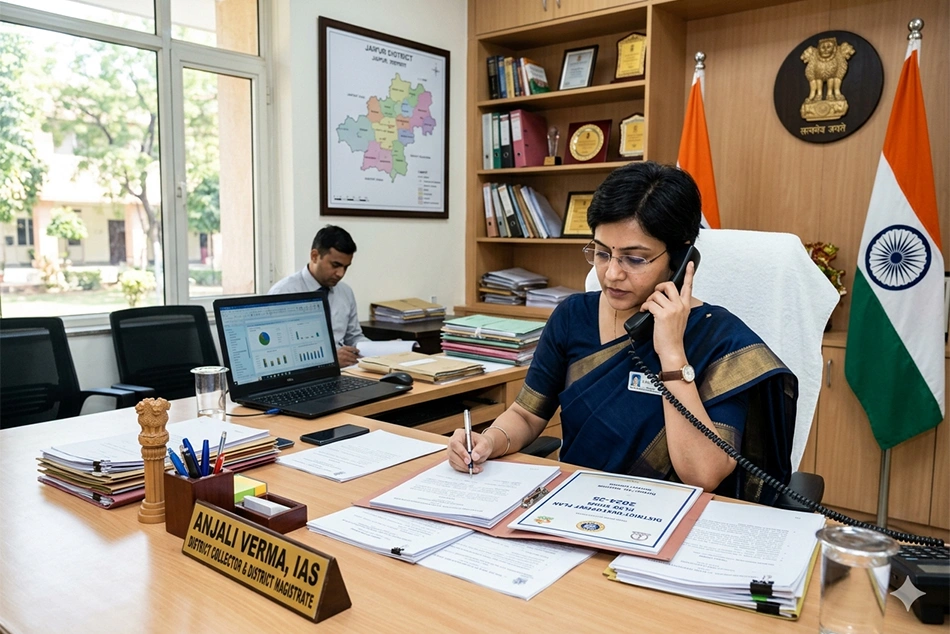
[An IAS Officer at work (Gemini AI image for representation)]
On one hand, the nation speaks confidently about becoming a global leader in artificial intelligence, digital innovation, and advanced manufacturing. On the other hand, some of its brightest scientific minds leave laboratories, hospitals, and engineering careers to prepare for administrative examinations.
The pattern has repeated itself over the years. Many of those who top the civil services examination come from highly technical backgrounds. Shah Faesal, who secured the first rank in 2009, was a medical doctor with an MBBS degree from the Sher-i-Kashmir Institute of Medical Sciences before entering the civil services. In 2018, Kanishak Kataria, an IIT Bombay graduate in computer science, topped the examination after leaving a promising engineering career. More recently, the 2025 results again reflected the same trend when Anuj Agnihotri, a medical professional, secured the top rank.
These individuals are exceptionally talented. Their achievements deserve admiration. Yet their stories raise a deeper question:
Why does a nation that urgently needs innovators repeatedly redirect its most technically trained minds into administration?
And behind this national ritual lies a question India rarely confronts:
Is a single examination the best way to choose the people who will run one of the most complex and technologically ambitious nations on earth?
After independence, the civil services system was retained and adapted for a democratic republic. The logic seemed sensible - select talented graduates through a competitive examination, train them in governance, and deploy them across districts and ministries. For the early decades of nation-building, the arrangement worked reasonably well. Governance largely involved managing land records, implementing welfare programmes, and maintaining administrative stability. But the 21st century presents a very different set of challenges.
Today’s policy debates increasingly revolve around artificial intelligence, biotechnology, cybersecurity, renewable energy, climate resilience, digital governance, and advanced manufacturing. These are not purely administrative questions. They are technical issues that require deep knowledge and years of professional experience.
Yet India’s bureaucratic model still assumes that a brilliant young graduate, selected in their twenties, can rotate across sectors ranging from agriculture to telecommunications and from public health to industrial policy. Over time, officers are expected to manage complex technical departments regardless of their original academic background.
Even the most capable individuals face obvious limits in such a system. It is difficult to develop genuine expertise across multiple specialized fields. Modern governance, however, increasingly demands exactly that kind of expertise.
Also Read: Delhi's IAS Making Factories
Consider how policy might look if leadership emerged from long professional engagement within specific sectors. Infrastructure ministries could be led by engineers who have spent decades designing transport systems or energy networks. Health departments might be guided by physicians and epidemiologists who understand medical systems from direct experience. Environmental policy could benefit from the leadership of climate scientists and ecologists who have spent years studying fragile ecosystems.
The same argument applies at the district level. District administrators today confront issues that extend far beyond traditional revenue management. They must deal with urban planning, disaster preparedness, environmental protection, agricultural innovation, digital governance, and public health administration. Many of these areas involve technical complexities that general administrative training alone cannot fully address.
Many advanced economies have gradually adapted to these realities. In countries such as the United States and Germany, senior government roles in science, health, and technology are frequently filled by academics, scientists, engineers, or industry leaders who enter public service after distinguished careers. Their authority comes not only from administrative appointment but also from decades of professional credibility.
Such models do not eliminate the need for administrators. Effective governance still requires coordination, institutional management, and policy implementation. But the balance changes. Instead of a purely generalist system, governance becomes a partnership between administrators and domain experts.
India faces another challenge that deserves attention. The prestige of the civil services continues to draw many talented graduates away from research and innovation. Engineers, scientists, and doctors often see administrative careers as the most respected and secure professional path. As a result, the country’s innovation ecosystem sometimes loses individuals who might otherwise have contributed to scientific discovery or technological entrepreneurship.
If governance roles were designed to welcome accomplished professionals later in their careers, the incentives might change. Young scientists and engineers could spend decades building technologies, conducting research, or developing industries before entering public service. When they eventually assume leadership roles, they would bring with them practical knowledge and real-world experience. Such a shift would not weaken governance. On the contrary, it could strengthen policymaking by ensuring that decisions are informed by deep understanding of the sectors involved.
India frequently speaks about becoming a global leader in innovation and realizing the vision of Viksit Bharat. Achieving that vision will require more than economic growth. It will require institutions that reward knowledge, creativity, and technological achievement.
Reforming the administrative system does not mean dismissing the contributions of existing civil servants. Many officers have served the country with dedication and integrity. The issue lies not with individuals but with institutional design. A system created in the 19th century to manage a colonial empire may not be ideally suited for governing a 21st century knowledge economy.
India stands today at a moment of enormous opportunity. It aims to build world-class universities, develop cutting-edge technologies, strengthen manufacturing, and compete globally in emerging scientific fields. To realize these ambitions, the country must ensure that its governance structures draw upon the deepest pools of expertise available.
Moving gradually from a purely generalist bureaucracy toward a model of expert governance — where accomplished professionals enter leadership roles after years of innovation and service, could be an important step in that direction.
It would signal that national leadership can emerge not only from examination halls but also from laboratories, hospitals, engineering workshops, research institutions, and entrepreneurial ventures. In the long run, a nation that values its innovators as much as its administrators will stand a far better chance of building the technological future it hopes to lead.
[The writer, Obeida, is a Teacher by profession.]
Follow ummid.com WhatsApp Channel for all the latest updates.
Select Language to Translate in Urdu, Hindi, Marathi or Arabic