Ram Mandir Robbery and Rise of Hindutva Thug Republic
The Ayodhya scandal is however significant because the Ram Mandir is not merely a temple, as it is the central symbol of a political project that transformed Indian politics over the last four decades
“Anta unnatīchā patanīṁ hoi yā jagānt
Sarva saṅgrahāchā vatsā, nāś hācha anta”“In this world, every rise is followed by decline.
Every accumulation, dear one, ends in loss”
These lines from the famous Marathi poet G.D.Madgulkar’s Geet Ramayan, rendered soulfully by Sudhir Phadke, depict Lord Ram advising his brother Bharat not to beseech him to return to Ayodhya. On his way to exile into the forest, Ram frames his banishment as being nobody’s fault except his own and argues that “Man lives subject to forces greater than himself.”
It is poetry that very poignantly captures one of the central themes of Hindu philosophy over the centuries, about the acceptance of fate, the impermanence of worldly things, and the duty to uphold righteousness despite personal suffering.
It is a message that seems to be completely lost on the likes of Champat Rai, General Secretary of the Shri Ram Janmabhoomi Teerth Kshetra currently under a cloud for theft of crores of rupees worth of jewels, gold, silver and cash missing from the grand temple for Ram in Ayodhya. The accusations involve not just missing valuables but manipulated accounting records and even the disappearance of crucial CCTV footage.
From the looks of it, Rai and perhaps even his political bosses in the Rashtriya Swayamsevak Sangh (RSS) and the ruling BJP regime in Delhi, were involved in a quest for permanent wealth, enough to fund several generations of family after them.
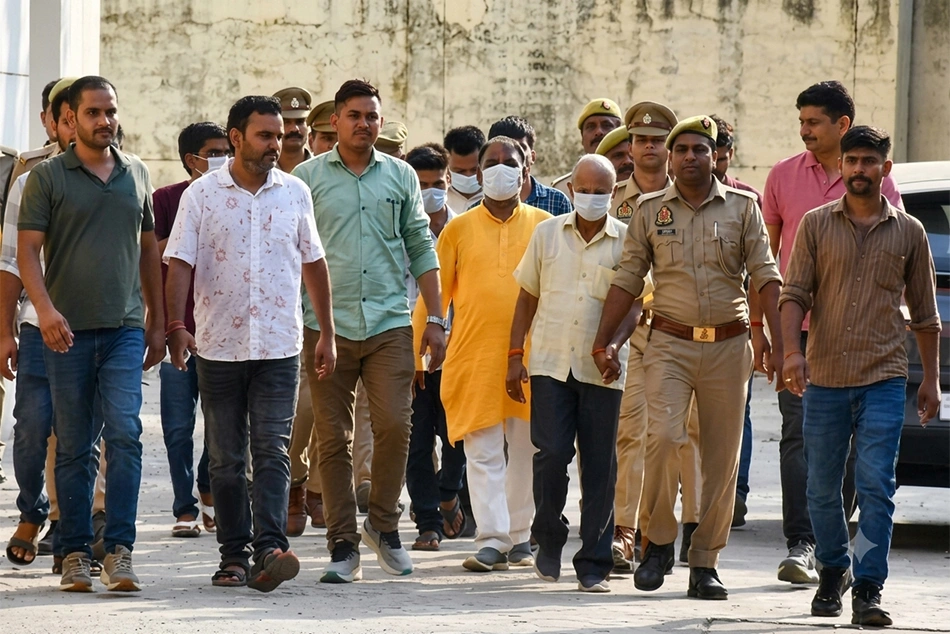
So far, the UP police based on the report of a Special Investigation Team, has arrested a number of minor employees at the temple for the theft, which seems to have happened on a regular basis since the inauguration of the Ram temple in 2023 by Prime Minister Narendra Modi. Critics have accused the UP government of a ‘cover up’ and asked why Champat Rai, one of the key figures associated with the movement to build the controversial temple on the site of the demolished 500 year old Babri Masjid, has not been charged as yet.
While the fact that such a scandal could occur at one of the most revered religious sites in India is shocking, the phenomenon of stealing from temples, unfortunately, is not surprising at all. Throughout history, religious institutions have accumulated enormous wealth in the form of donations from believers. Wherever wealth accumulates, opportunities for corruption, theft and misuse inevitably follow. Temples, churches, mosques, monasteries and gurudwaras are not exempt from the ordinary laws of human behaviour merely because they are associated with the sacred.
Indeed, if one surveys the history of religion across the world, one finds that many of the most spectacular cases of fraud, embezzlement and theft have occurred not outside religious institutions but within them. The thieves have often been not outsiders but insiders—those entrusted with managing the wealth of God.
In the Indian context, this phenomenon is particularly visible because temples have traditionally received enormous offerings in cash, gold, silver, jewellery and land. From the famous temples of Tamil Nadu and Kerala to shrines in North India, allegations of missing donations, manipulated accounts and misuse of temple property have surfaced repeatedly over the decades.
The irony is that devotees offer wealth to God in the belief that it will be used for religious purposes. Yet the deity rarely controls the treasury. Human beings do. And human beings are fallible.
The problem extends beyond Hindu institutions. The Catholic Church has faced repeated financial scandals involving priests, bishops and even Vatican officials. Televangelists in the United States have accumulated fortunes while preaching poverty and sacrifice. Religious trusts in many Muslim countries have been accused of corruption and diversion of charitable funds. No religion possesses immunity from greed. The issue is therefore not theology but power.
When faith becomes institutionalized, a priestly class emerges. The priest gains access to sacred knowledge, controls rituals, manages donations and regulates access to the divine. Such authority inevitably creates opportunities for abuse. The believer arrives with faith; the institution often sees revenue.
The Ayodhya scandal is however significant because the Ram Mandir is not merely a temple. It is the central symbol of a political project that transformed Indian politics over the last four decades.
The movement that brought the Bharatiya Janata Party to power mobilized millions of Hindus around the demand to demolish the Babri Masjid and construct a grand temple at what was claimed to be the birthplace of Lord Ram. The temple became both a religious aspiration and a political instrument.
For supporters, the temple represented the correction of a historical injustice. For critics, it symbolized the fusion of religion and majoritarian politics. Either way, the Ram Mandir became the crown jewel of the Hindutva project.
Yet what exactly is this project?
While there are plenty of contemporary factors one way of understanding it historically is to view it as an attempt to revive, in modern form, the Peshwa Raj, which dominated very large parts of India in the eighteenth and early nineteenth centuries. The Chitpavan Brahmins of Maharashtra who became Peshwas under Chatrapati Shivaji and took over the reins of power from his grandson Chatrapati Shahu, presided over the last major Brahmin-led political order in pre-colonial India.
Many of the intellectual currents that have shaped modern-day Hindu nationalism can be traced to the anxieties and aspirations of this community, that experienced the collapse of the old Maratha order after British conquest. The decisive moment came in 1818 when Peshwa Baji Rao II, in return for a lifelong alimony, surrendered to the East India Company following the Third Anglo-Maratha War.
One of the consequences of this capitulation was that many soldiers, retainers and dependents who had relied on the Peshwa state suddenly found themselves displaced. Some historians have argued that the rapid rise of the thuggee networks of central India in the early nineteenth century was due to the economic distress the large numbers of armed men who lost their livelihoods during the transition from Maratha to British rule.
The thuggees themselves occupied a peculiar space between religion and crime. They justified robbery and murder through elaborate religious narratives. Many claimed devotion to Bhawani or Kali. They travelled with pilgrims, won their confidence and then robbed and killed them. Their crimes were hidden beneath ritual, symbolism and sacred language.
The point is not that modern Hindutva activists are literally thuggees. History never repeats itself so neatly. The point is that there exists a striking similarity in method.
The thuggee tradition used religion as camouflage for criminal activity. It transformed theft into sacred duty. The modern-day Hindutva movement, similarly, has attracted a vast range of opportunists, profiteers, strongmen and career criminals who cloak themselves in religious symbolism and nationalist rhetoric. The slogan has changed from “Jai Bhawani” to “Jai Shri Ram,” but the principle remains familiar: religious identity becomes a shield against scrutiny.
This does not mean that every person who chants “Jai Shri Ram” is a criminal. Millions do so out of genuine faith and devotion. But it does mean that the slogan has increasingly become available for political and economic manipulation.
It is not a coincidence that the RSS, which is the progenitor of the Hindutva movement, is totally dominated by the Chitpavan Brahmins, descendants of the community that produced the Peshwas. When the RSS ideologues speak of establishing a ‘Hindu Rashtra’ they are essentially talking about the return to the glory days of their own ancestors during Peshwa rule. These are not spiritual men but political entrepreneurs.
The scandal at the Ram temple in Ayodhya should also be understood in the larger perspective of what has been happening in India ever since the Hindutva regime of Narendra Modi came to power in 2014. Over the last decade, India has witnessed an unprecedented concentration of political, economic and media power. Public resources have increasingly flowed toward a small group of politically connected corporations. Regulatory institutions have weakened. Independent voices have faced pressure. Electoral competition has become increasingly unequal.
In this broader context, the alleged theft at the Ram Mandir appears less like an isolated scandal and more like a symptom of a larger political economy. The same system that encourages unquestioning reverence toward religious authority often demands unquestioning reverence toward political authority. In both cases, accountability becomes secondary to faith.
And wherever accountability disappears, corruption flourishes. The lesson of Ayodhya therefore extends far beyond one temple or one investigation. It is a reminder that religion cannot substitute for transparency, nationalism cannot substitute for ethics, and devotion cannot substitute for democratic oversight.
The greatest danger facing any society is not that criminals do not fear or believe in God. It is that criminals learn to hide within religion and successfully claim to be the moral and spiritual guides of entire nations.
This is exactly what the dispossession of Lord Ram from his own temple in Ayodhya signifies as the dismal reality of contemporary India.
[The writer, Satya Sagar, is a Journalist and Public Health Worker. He can be reached at sagarnama@gmail.com.]
Follow ummid.com WhatsApp Channel for all the latest updates.
Select Language to Translate in Urdu, Hindi, Marathi or Arabic