What should children learn in the age of AI? China explores solution
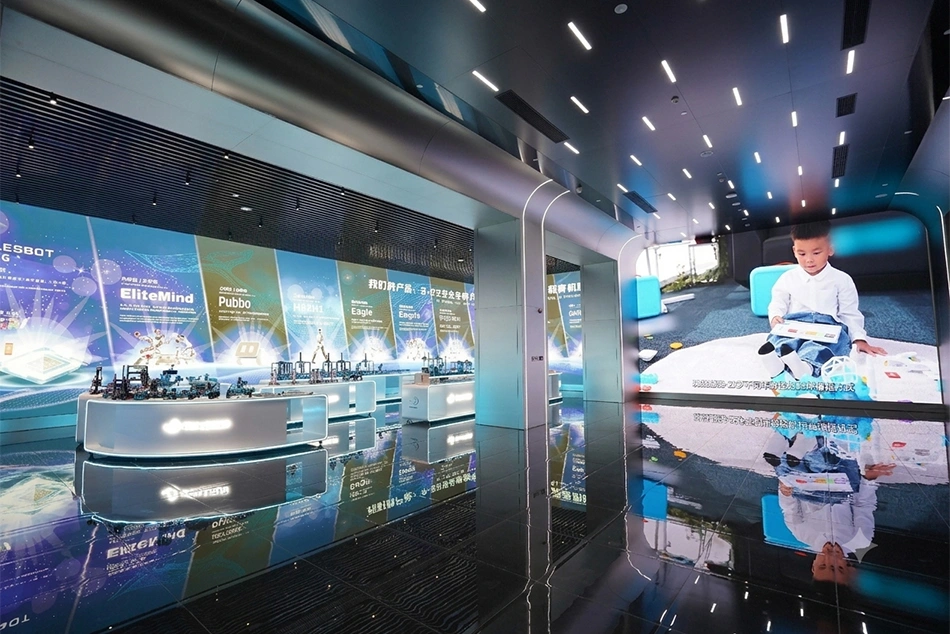
With the focus to find answer to this question, schools and local communities at WhalesBot's AI+Robotics Exploration Centers spread across China are building spaces focused less on passive technology consumption and more on hands-on interaction with robotics, engineering, coding, competitions, drones, and real-world experimentation.
Shanghai: Parents and teachers across the globe are worried about what should children learn in the era when the Artificial Intelligence (AI) is disrupting the conventional teaching system and threatening the knowledge acquiring capacities.
With the focus to find answer to this question, schools and local communities at WhalesBot's AI+Robotics Exploration Centers spread across China are building spaces focused less on passive technology consumption and more on hands-on interaction with robotics, engineering, coding, competitions, drones, and real-world experimentation.
The leading robotics company based in Shanghai, China that specializes in robotics and AI education, on June 27, 2026 launched its second AI+Robotics Exploration Center in Jiaxing, Zhejiang Province.
This comes after a recent launch of a similar project in China's Anhui Province that included a nearly 5,000-square-meter AI+Robotics Exploration Center designed around robotics exhibitions, immersive learning spaces, competition areas, AI and robotics classrooms, and project-based exploration for the students aged 3 to 22.
“Off-Screen AI Education”
WhalesBot is also involved in an ongoing collaboration with Peking University, where a three-floor AI and technology learning center with more than 1,800 square meters per floor is currently under development. Similar Exploration Center projects and regional collaborations are also being explored in other cities across China.
“At these centers, students are not just sitting in front of screens. They are testing robots, debugging sensor behavior, flying drones, and building systems that don't work the first time. Such physical interaction matters more than people think”, WhalesBot said.
In the AI industry, terms like "physical AI" or "embodied AI" are now starting to be used to describe intelligence interacting with the real world instead of existing only digitally. “In education, a similar shift may already be starting to happen”, the company said.
As AI can instantly generate answers, images, code, and even ideas, the value of learning may gradually move toward things that are harder to automate: reasoning, experimentation, judgment, curiosity, teamwork, adapting to failure, understanding how systems behave in unpredictable environments.
AI Foundations Learning
According to WhalesBot, this has gradually evolved into what it calls AI Foundations Learning — combining robotics, coding, engineering, AI concepts, competitions, and project-based learning into a more connected pathway, instead of treating AI as a completely isolated subject.
Moreover, WhaleBot's programs like ENJOY AI, which is the largest robotics competition in the world, follow the same direction. Students solve challenges together, test ideas under pressure, rebuild after failure, and learn through interaction, instead of only instruction.
“The technology itself will keep changing, probably faster than schools can fully adapt to. But there is a growing sense among many educators that AI learning cannot stay only on screens. Students still need to build things, test ideas in the real world, and work with uncertainty”, the company said.
Follow ummid.com WhatsApp Channel for all the latest updates.
Select Language to Translate in Urdu, Hindi, Marathi or Arabic