Why is Hindutva Gang Protecting Dharmendra Pradhan?
What began as a demand for the resignation of Dharmendra Pradhan may eventually evolve into a broader movement challenging what critics describe as the RSS control over the education system
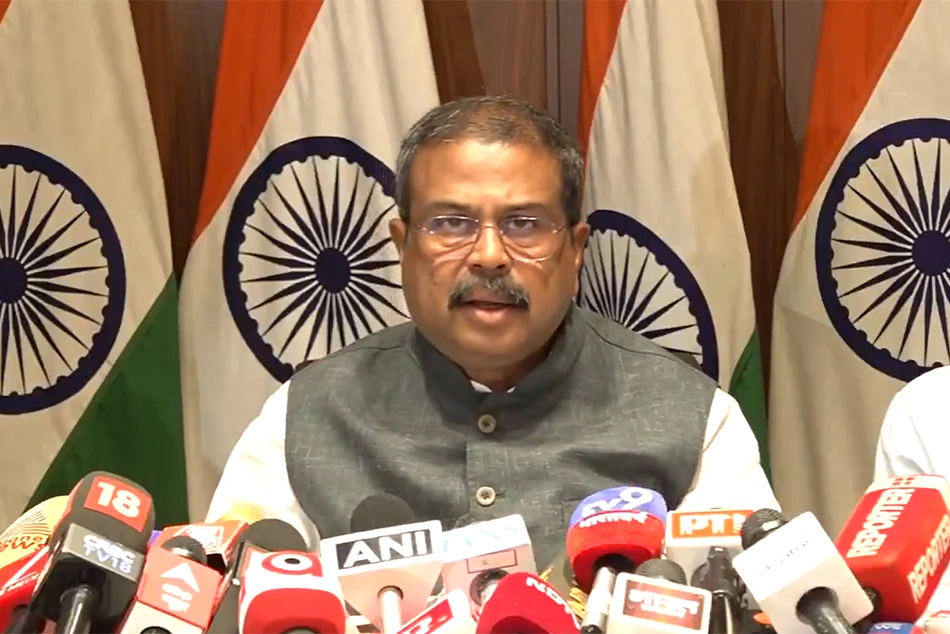
The issues of education, examinations, and employment have become a source of deep pain, insecurity, and frustration for India’s youth. Their anger is visible both on social media and on the streets.
On June 6, 2026, young people have called for a protest at Jantar Mantar. Abhijeet Dipke, founder of the Cockroach Janata Party (CJP), is returning to India and has urged young people through social media to gather at Parliament Street Police Station near Jantar Mantar. On the same day, the Employment Rights Campaign has announced a nationwide campaign on X (formerly Twitter).
The common demand is that accountability must be fixed for the NEET paper leak and the irregularities in CBSE answer-sheet evaluation, and that Union Education Minister Dharmendra Pradhan should resign. If he does not resign voluntarily, they say, Prime Minister Narendra Modi should remove him from the Cabinet.
This demand has also been raised by Leader of the Opposition (LoP) Rahul Gandhi, various student and youth organizations, and protesting students across the country.
Instead of considering this widely supported and minimal demand, the entire Bharatiya Janata Party (BJP) and the Rashtriya Swayamsevak Sangh (RSS) have come forward in the defense of Education Minister Dharmendra Pradhan.
The question is:
If Dharmendra Pradhan himself has acknowledged that lapses occurred and has accepted a degree of responsibility, why is he not being removed from office? Why is his resignation not being sought?
The answer, it appears, lies in the fact that over the last twelve years, the RSS has established what may be described as deep-state control over India’s education system. Since the BJP-led NDA government came to power in 2014, the RSS has implemented extensive changes at every level of education in accordance with its Hindutva ideological vision.
Curricula have been revised.
Historical narratives have been rewritten, reinforcing interpretations rooted in colonial-era communal frameworks.
Large sections of history covering the Sultanate and Mughal periods have been removed from school curricula.
Instead of promoting scientific temper, as envisioned under Article 51A(h) of the Constitution, educational institutions have increasingly encouraged conservative and unscientific thinking. University autonomy has been curtailed in the name of uniformity, reshaping institutions according to a centralized ideological framework.
The RSS has also allegedly facilitated the appointment of individuals aligned with its ideology as Vice-Chancellors and faculty members in Higher Education Institutions. Academic appointments increasingly appear to prioritize affiliations with the Akhil Bharatiya Vidyarthi Parishad (ABVP). As a result, many qualified candidates have been sidelined, while incompetence and mediocrity have gained ground. Institutions such as NCERT, once respected for producing scientific and high-quality educational materials, have been weakened, and bodies such as the UGC have seen their authority diminished. The pain and resentment now being expressed by young people are, in this view, a direct consequence of these policies.
Consider the NEET examination. It is currently conducted by the National Testing Agency (NTA), a non-constitutional body. NEET was originally introduced in 2013 to simplify medical admissions and reduce the financial burden on students who otherwise had to sit for multiple entrance examinations and submit numerous applications. Initially, the examination was conducted by the CBSE, a statutory institution directly accountable to the government. Similarly, the Joint Entrance Examination (JEE) was conducted by the IITs, which are public institutions established under law.
However, in 2017, the government created the NTA, which is registered under the Societies Registration Act rather than being a statutory body. Consequently, direct governmental accountability is limited. Despite repeated demands, the NTA has yet to publish its bylaws on its website. Nevertheless, it is responsible not only for NEET but also for prestigious examinations such as JEE, UGC-NET, CUET, CMAT, GPAT, and others.
Also Read: National Education Policy Against Scientific Temperament
It is well known that the 2024 NEET examination conducted by the NTA was also affected by a paper leak scandal. Following widespread protests and intervention by the Supreme Court, re-examinations were held at certain centres. This year, when the matter once again reached the Supreme Court, the Court observed that had accountability been fixed in the earlier paper leak case, such incidents might not have recurred. Yet this significant observation appears to have had little impact on the government’s approach.
The state of governance can be seen from the fact that Subodh Kumar Singh, who served as NTA Director General during the 2024 NEET paper leak controversy, is now serving as Principal Secretary to the Chief Minister of Chhattisgarh. Pradeep Kumar Joshi, who was NTA Chairman in 2024, continues to hold the position. Joshi previously served as Chairman of the Madhya Pradesh Public Service Commission from 2006 to 2011.
During that period, allegations involving examination irregularities, solver gangs, impersonation, and OMR manipulation emerged in what later became known as the Vyapam scandal. Critics argue that these controversies cast a shadow over his tenure. Additionally, photographs circulating on social media allegedly show individuals arrested in the paper leak investigation posing alongside Dharmendra Pradhan and BJP leaders.
A similar pattern can be observed in CBSE’s online screen-marking system for answer-sheet evaluation. Significant flaws and conflicts of interest have been alleged. Student Vedant Srivastava exposed irregularities in the scanning of answer sheets. 19-year-old student Nisarga Adhikari reportedly bypassed security measures on an edutech platform and revealed weaknesses in the system. Sarthak Siddhant, a Class 12 student from Jharkhand, highlighted the alleged irregularities in the tendering process. Questions have been raised about the decision to award contracts to Coempt Eduteck Private Limited instead of more experienced firms such as Tata Consultancy Services (TCS). Social media discussions have also pointed to alleged links between the company and institutions perceived to be close to the ruling establishment.
Overall, it appears that the future of millions of students has been compromised for short-term gains.
The same situation is visible in competitive examinations across the country. In Uttar Pradesh, a popular saying has emerged that every recruitment examination now passes through several stages: preliminary examination, mains examination, interview, paper leak, CBI investigation, High Court, and Supreme Court.
The credibility of recruitment bodies has been seriously eroded. Millions of government vacancies remain unfilled. Instead of addressing these concerns, the government has increasingly focused on suppressing student protests. From Prayagraj to other parts of the country, students and young activists continue to face administrative action and repression.
Nevertheless, the younger generation is increasingly choosing the path of democratic protest. Resistance is visible both on social media and on the streets. What began as a demand for the resignation of Dharmendra Pradhan may eventually evolve into a broader movement challenging what critics describe as the RSS control over the education system. According to this perspective, this is the real reason why the entire political and administrative establishment is working to protect the Education Minister.
[The writer, Dinkar Kapoor, is State General Secretary, All India People’s Front, Uttar Pradesh]
Follow ummid.com WhatsApp Channel for all the latest updates.
Select Language to Translate in Urdu, Hindi, Marathi or Arabic