Interstellar comet 3I/ATLAS comes nearest to Earth ahead of Christmas
Interstellar comet 3I/ATLAS is coming nearest to Earth on December 19, and astronomers are eager to welcome it as a Christmas 2025 gift
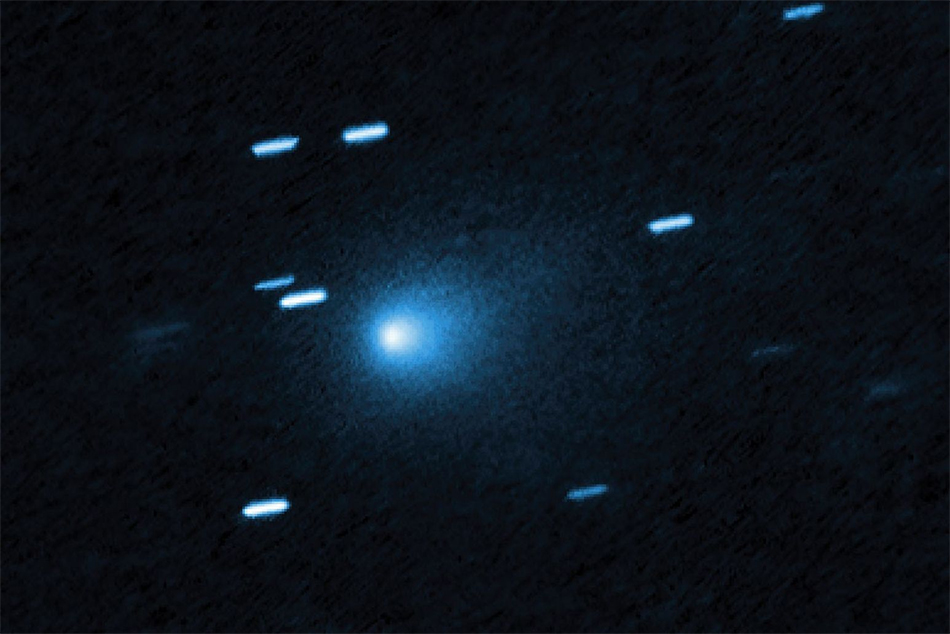
[Hubble captured this image of the interstellar comet 3I/ATLAS on July 21, 2025, when the comet was 277 million miles from Earth. Hubble shows that the comet has a teardrop-shaped cocoon of dust coming off its solid, icy nucleus. Image: NASA, ESA, David Jewitt (UCLA); Image Processing: Joseph DePasquale (STScI)]
Interstellar comet 3I/ATLAS is coming nearest to Earth on December 19, and astronomers are eager to welcome it as a Christmas 2025 gift.
Comet 3I/ATLAS is the only third confirmed object from outside the solar system after 'Oumuamua (2017) and comet 2I/Borisov (2019).
3I/ATLAS Discovery
The NASA-funded ATLAS (Asteroid Terrestrial-impact Last Alert System) survey telescope in Rio Hurtado, Chile, first reported observations of a comet that originated from interstellar space on July 1, 2025.
Arriving from the direction of the constellation Sagittarius, the interstellar comet has been officially named 3I/ATLAS.
Initially dubbed A11pl3Z, the interstellar comet 3I/ATLAS was visible to ground-based telescopes through September, after which it made its closest approach to the Sun in October this year.
NASA’s Hubble Space Telescope re-observed 3I/ATLAS on November 30, 2025 with its Wide Field Camera 3 instrument.
3I/ATLAS Near Earth Date
It is now coming nearest to the Earth on December 19, 2025 - six days before Christmas, NASA said.
"On December 19, 2025 this erratic wanderer will be the closest to Earth that it will ever be over the lifetime of the entire universe", Space.com said in a report.
Skywatchers will be able to catch a glimpse of it up close with a small telescope or very powerful binoculars.
Hubble’s observations allowed astronomers to more accurately estimate the size of the comet’s solid, icy nucleus. The upper limit on the diameter of the nucleus is 3.5 miles (5.6 kilometers), though it could be as small as 1,000 feet (320 meters) across, researchers report.
The close approach of the comet to Earth also offers astronomers their best opportunity to look up close and learn about how planet formation in exoplanetary systems is similar or different to how it unfolded in our solar system.
Follow ummid.com WhatsApp Channel for all the latest updates.
Select Language to Translate in Urdu, Hindi, Marathi or Arabic