Newton as Pilot, Equinox as Equator – What India is Teaching Today?
The Odisha textbook crisis is a microcosm of a larger failure - the failure to treat poor children as full citizens whose education deserves the same standard of care and investment as any electoral scheme
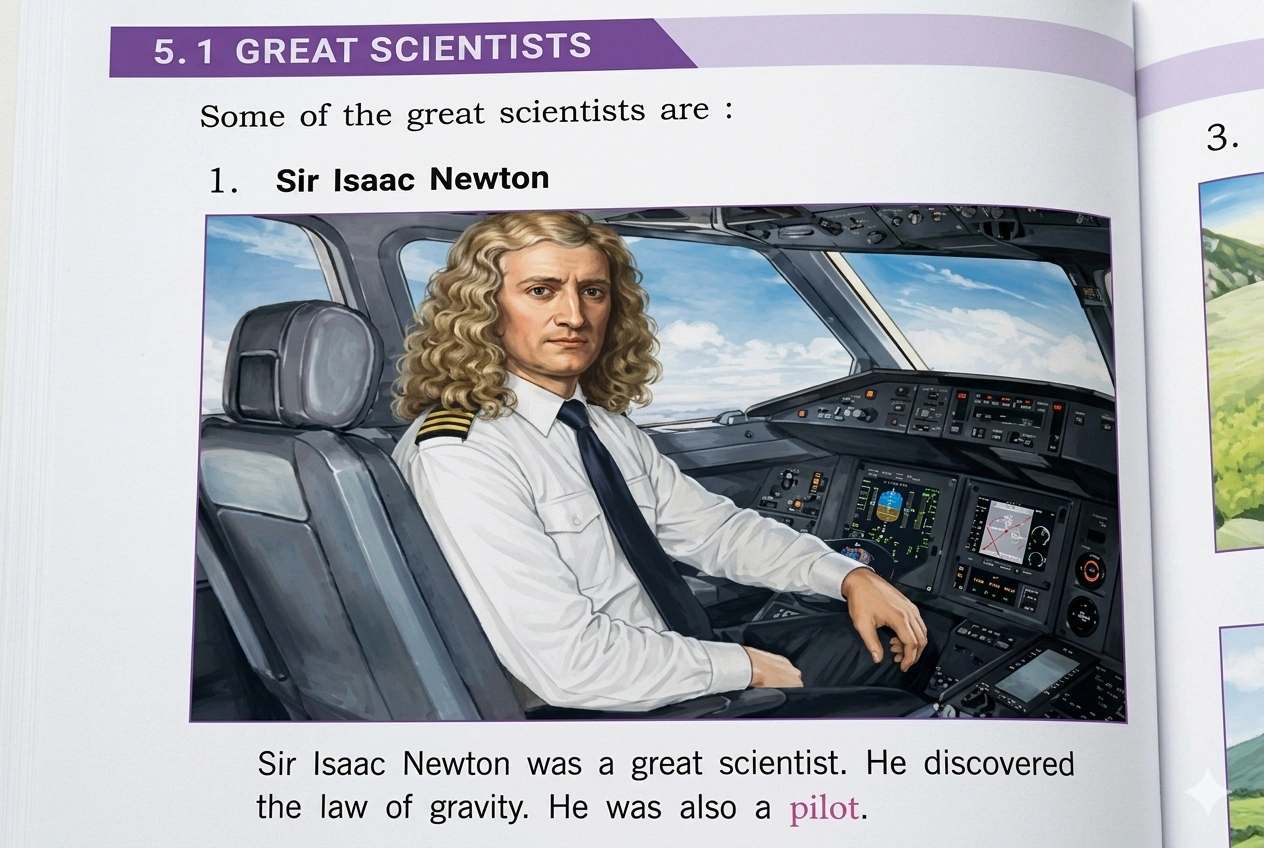
In a government school somewhere in Odisha, a child opens a brand new Science textbook and reads:
“I am Sir Isaac Newton, a great pilot.”
The image alongside shows Newton — the man who gave the world calculus and the laws of motion, dressed in aviator glasses and a pilot’s uniform, holding a toy plane. This is not satire. This is not a meme. This is what the Odisha government, under the BJP’s Mohan Charan Majhi, delivered to lakhs of children for the 2026–27 academic session.
The revelation of 1,678 documented errors — spanning spelling mistakes, factual blunders, and contextual absurdities, across school textbooks for Classes I to VIII has ignited a firestorm. Yet the response from those entrusted with shaping young minds has been more instructive than any of those flawed textbooks. It tells us exactly where children stand in India’s hierarchy of public priorities: Somewhere near the bottom, just above where accountability begins.
“Since the books were produced within a short timeframe, some printing and editing errors may have occurred.”
— School & Mass Education Minister Nityananda Gond
A Catalogue of Shame
Let us be precise about what 1,678 errors mean. These are not occasional typos scattered across a vast publishing enterprise. They are systemic failures concentrated most densely in Class VIII textbooks, which alone account for 705 mistakes — 294 in Jijnasa, 114 in Sanskrit, 25 in Social Science, and 31 in Literature, along with significant errors in English and Mathematics.
Isaac Newton is introduced as a “great pilot.” Another passage states he boiled water — the intended anecdote, a well-known story of his legendary absent-mindedness, had him boiling his pocket watch while lost in thought. The ancient temple complex of Hampi, a UNESCO World Heritage Site in Karnataka and one of India’s greatest monuments to Vijayanagara civilisation, has been mislabelled as the Konark Sun Temple, which stands hundreds of kilometres away in Odisha itself. The equinox — an astronomical event central to understanding Earth’s movement — is called the “equator.”
These are not typographical accidents. They are epistemic failures. They reveal a process in which textbooks were written, reviewed, edited, and approved for lakhs of children without anyone in the chain having sufficient knowledge, care, or time to catch errors so elementary they would embarrass a reasonably attentive student.
The SCERT’s Defence: An ‘Experimental Edition’
The State Council of Educational Research and Training (SCERT), the body directly responsible for the textbooks, chose an unusual line of defence. Rather than acknowledging the institutional failure, SCERT classified the textbooks as an “experimental edition” and termed the errors “minor.” A corrigendum — a printed correction slip — was issued to schools. Teachers were expected to make manual fixes in their classrooms, essentially correcting the state’s errors on the state’s behalf, without additional pay, time, or resources.
This framing is worth examining carefully. By calling a textbook an “experimental edition,” SCERT insulates itself from accountability while placing the burden of correction on the most stretched link in the chain: the classroom teacher. The children in those classrooms, meanwhile, are expected to navigate contradictions between what the book says, what the teacher corrects, and what will appear in their examinations. In a country where the textbook remains the primary — often only — learning resource for children from poor families, treating such a document as a draft is not a pedagogical strategy. It is an abdication.
“Textbooks are not just printed material; they are the foundation of how children understand science, history, geography and civic life.”
The Minister’s Mathematics
School and Mass Education Minister Nityananda Gond, a lawyer and BJP MLA from Umerkote in Nabarangpur district, offered the government’s first line of response. The books were produced under a tight timeline aligned with the National Education Policy 2020 framework, he explained.
“Since the books were produced within a short timeframe, some printing and editing errors may have occurred,” he said.
Corrections were underway. All identified mistakes had been compiled. The department had initiated corrective measures.
The minister’s statement is a masterclass in passive-voice governance. Errors “may have occurred.” Corrections are “underway.” Nobody caused this; it simply happened. There is no acknowledgement of what it costs — in cognitive terms — for a child to learn from a textbook that has been manually annotated with corrections in pen. There is no reckoning with what happens to children whose teachers do not catch every error, or who are absent when corrections are verbally communicated, or who study from home using only the printed text.
Chief Minister Majhi, to his credit, took a firmer stance. A three-member high-level committee was constituted under Development Commissioner Deoranjan Kumar Singh, tasked with identifying the lapses in the textbook preparation process and submitting a report within seven days. But the formation of an inquiry committee, however well-intentioned, does not answer a prior question: how did ₹50 crore — the widely cited printing expenditure for this exercise — travel through the hands of SCERT, the Directorate of Teacher Education, steering committees, subject experts, and printers, with no one responsible enough to catch that Newton had become an aviator?
The Subhadra Equation
Fifty crores is a number that demands context. The Odisha government’s Subhadra Yojana — a women-centric direct benefit scheme launched with great fanfare by Prime Minister Modi on September 17, 2024 — carries a total outlay of ₹55,825 crore over five years. For the 2024–25 fiscal alone, the revised budget estimate was ₹8,570 crore. The scheme, which provides ₹10,000 annually in two instalments to eligible women aged 21 to 60, was a central BJP election promise and has been implemented at scale, reaching over 1.07 crore enrolled women across all 30 districts.
Subhadra is not, in itself, indefensible. Direct transfers to women can generate economic activity and reduce household vulnerability. But the scale and political prioritisation of Subhadra — inaugurated personally by the Prime Minister, allocated budgets that dwarf education spending, marketed as the cornerstone of the government’s first year — reveals the hierarchy of political investment. Schemes that generate electoral visibility receive money, momentum, and ministerial attention. Textbooks, which generate no ribbon-cutting ceremony, receive a rushed experimental edition.
The contrast is not merely financial. It is moral. Subhadra offers ₹50,000 to women over five years — a transfer that will, for many families, make a genuine short-term difference. But a child educated on textbooks that describe Newton as a pilot will carry that distorted foundation into every subsequent year of schooling, into competitive examinations, and ultimately into the labour market. Welfare transfers address poverty’s symptoms. Education, when it functions, addresses its causes. When it malfunctions — and 1,678 errors constitute malfunction — it compounds disadvantage.
Schemes that generate electoral visibility receive money and momentum. Textbooks, which generate no ribbon-cutting ceremony, receive a rushed experimental edition.
The Systemic Anatomy of Failure
To understand how this happened, one must understand the institutional pipeline through which these textbooks travelled. The books were developed by SCERT and the Directorate of Teacher Education under the Odisha Curriculum Framework for School Education 2025, aligned with NEP 2020, and intended for use from the 2026–27 academic session. A steering committee was constituted to oversee implementation. Experienced teachers and subject experts were supposedly involved at every stage.
And yet, 1,678 errors reached the printing press. This is not the failure of a single individual. It is the failure of a system that compresses review timelines, does not adequately compensate or empower subject experts, and treats the production of children’s textbooks as an administrative exercise in meeting deadlines rather than an intellectual exercise in building knowledge. When the Primary School Teachers’ Association president Brahmananda Maharana demanded a thorough review of the preparation process, he was not calling for the punishment of one careless editor. He was calling for the reckoning of an entire system.
Teacher associations have rightly questioned how such large-scale errors could go unnoticed despite the involvement of experts. The answer, uncomfortable as it is, involves a culture in which review is performative rather than substantive. Expert committees are constituted to provide institutional cover, not rigorous scrutiny. Deadlines are driven by political calendars — in this case, the need to roll out NEP-aligned materials before the academic year — rather than by the time required to produce quality. And when errors are eventually found, the cost is borne not by the system but by the children within it.
India’s Oldest Double Standard
The Odisha textbook scandal is not an isolated incident. It is, in fact, a recurring pattern with a consistent demographic signature. The children enrolled in Odisha’s government schools are overwhelmingly from poor, rural, tribal, and Dalit families. Nabarangpur district — from where the Education Minister himself is elected — is one of Odisha’s most economically vulnerable regions. A 2023 survey found that approximately 49.6 per cent of Odisha’s Socially and Educationally Backward Classes have either primary or sub-matriculation level education. These are the children for whom public textbooks are not a convenience but a lifeline.
Middle-class and upper-class children in English-medium private schools face no such roulette. Their textbooks are published by well-resourced national houses with editorial teams, fact-checkers, and market accountability. If a private publisher released a textbook calling Newton a pilot, it would face immediate market punishment — parents would stop buying, and schools would stop recommending. The government’s captive audience of poor children offers no such corrective mechanism. They cannot switch publishers. They cannot sue. They can only adjust.
And therein lies the phrase that should haunt every policymaker in this country: “adjust.” It is the default instruction to India’s poor when the state fails them. Adjust to the broken hospital with no doctors. Adjust to the school with no toilets. Adjust to the textbook with 1,678 errors. The systemic expectation of adjustment is not benign — it is the means by which institutional failure is normalised and accountability is permanently deferred.
What Accountability Would Actually Look Like
A seven-day inquiry committee is not accountability. It is the appearance of accountability, which is a different thing entirely. Real accountability in this instance would require several things that the government has not yet shown a willingness to provide.
First, a full public audit of the ₹50 crore expenditure on the textbook printing exercise — including the identities and qualifications of every consultant, committee member, reviewer, and printer who received payment. Second, a clear timeline of who approved what and when, and where in that chain the errors were introduced or allowed to pass. Third, structural reform of SCERT’s review mechanisms, including mandatory multi-stage review by independent subject experts before any textbook goes to press. Fourth, an unambiguous commitment to corrected reprints — not corrigenda, not manual teacher corrections, but clean books in children’s hands before the next examination cycle.
The government has, for now, chosen the corrigendum route. This is cheaper and easier. It is also, for the children sitting in those classrooms with their annotated textbooks, a statement about how much their education is worth.
Conclusion: The Cost of Experimental Children
In a democracy, the quality of a child’s education should not be determined by the income of their parents. This is the foundational promise of public education — that the state will provide every child with the tools to think, to reason, and to participate in national life. When Newton becomes a pilot in a government textbook, that promise is broken not in one classroom but in every classroom that received that book.
The Odisha textbook crisis is a microcosm of a larger failure: the failure to treat poor children as full citizens whose education deserves the same standard of care and investment as any electoral scheme. Subhadra will transfer money. Inquiry committees will file reports. Corrigenda will be issued. But the child who learned that Newton was a pilot — and never got the correction — will carry that error forward. Some errors, once made, are very hard to undo.
India cannot afford to keep running experiments on its most vulnerable children. It is time to stop treating their education as a provisional, adjustable, experimental affair — and start treating it as the non-negotiable foundation it was always meant to be.
[The writer, Nihar Nalini Sarangi, is a Socio-Political Analyst.]
Follow ummid.com WhatsApp Channel for all the latest updates.
Select Language to Translate in Urdu, Hindi, Marathi or Arabic