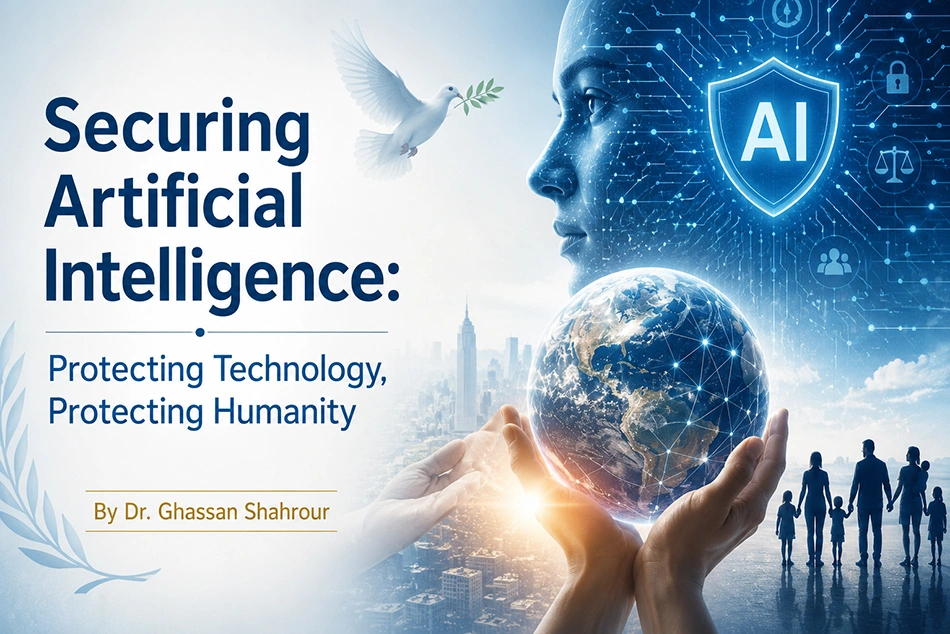
Securing Artificial Intelligence: Protecting Technology, Protecting Humanity
As artificial intelligence becomes increasingly embedded in everyday life, understanding its security is no longer a matter for technical experts alone. In this timely commentary, Dr. Ghassan Shahrour examines why protecting AI is inseparable from protecting privacy, human rights, and public trust, and argues that securing AI is a shared responsibility for all
Introduction
Artificial intelligence (AI) is rapidly becoming part of everyday life. It helps diagnose diseases, supports scientific research, improves education, and influences decisions that affect millions of people. Yet amid the excitement surrounding this technological revolution, one essential question is too often overlooked: Who is responsible for protecting AI, and whom are we ultimately protecting?
I still remember working with the first digital hospital systems. We trusted those early technologies because they helped us care for patients more effectively. At the time, none of us imagined that future systems would learn from human knowledge, influence decisions, and become deeply woven into daily life. Looking back, I realize that every technological advance also brings a new responsibility.
Protecting AI is no longer only a technical challenge. It is a shared responsibility that belongs to developers, governments, institutions, educators, and every person who uses these systems.
What Does AI Security Mean?
AI security means protecting intelligent systems from attacks that compromise privacy, manipulate decisions, or weaken public trust.
Common threats include:
- Model theft, where trained AI models are copied or reused without authorization.
- Prompt injection, where attackers attempt to bypass safety controls or extract confidential information.
- Private information inference, where responses are analyzed to determine whether specific personal data were included in the training process.
- Training data poisoning, where false or biased information is inserted into training datasets, producing inaccurate or discriminatory outcomes.
These are not distant or hypothetical risks. Around the world, AI security incidents have already demonstrated that behind every data breach or compromised system stands a human story. Privacy may be violated. Trust may be broken. Decisions that affect real lives may become unreliable.
Technology succeeds only when people can trust it.
Security Through Collaboration
The Coalition for Secure AI (CoSAI) brings together technology companies, researchers, universities, and civil society to strengthen AI security through shared standards, research, and practical tools.
Its mission focuses on securing AI infrastructure rather than addressing broader issues such as misinformation or harmful online content. Both technical security and ethical governance are essential, but they require different approaches.
During discussions with CoSAI participants at an international conference in October 2025, one message stood out clearly: protecting AI cannot be achieved inside laboratories alone. It requires continuous cooperation among engineers, policymakers, educators, researchers, and the public.
Security grows stronger when knowledge is shared.
The User's Role
Every user contributes to AI security.
Responsible users should:
- Avoid entering sensitive information into untrusted AI applications.
- Demand transparency about how personal data are collected, stored, and used.
- Report suspicious behavior, security concerns, or harmful outputs.
- Participate in testing and evaluation efforts that improve system safety.
Students, patients, professionals, and citizens increasingly rely on AI assisted decisions. Digital awareness is therefore no longer optional. It is the first line of defense.
Shared Responsibility
Building secure AI requires coordinated action.
- Developers must design transparent, secure, and accountable systems.
- Governments should establish effective regulations and promote digital literacy.
- Universities and the media should explain AI in language that is accurate and accessible.
- Civil society organizations should expand public awareness and encourage responsible AI use.
The security of AI is strongest when responsibility is shared rather than delegated.
How AI Can Be Compromised
AI systems can be compromised in several ways:
- Poisoning training datasets with false or manipulated information.
- Using prompt injection to bypass safety safeguards.
- Inferring confidential information from model responses.
Stealing trained models for unauthorized surveillance or other harmful purposes.
These attacks target more than software. They threaten the reliability of decisions that increasingly influence healthcare, education, finance, public services, and justice.
Reducing the Risks
Effective protection requires several complementary measures:
- Secure and regularly update AI infrastructure.
- Detect and remove manipulated or poisoned data.
- Apply strong access controls and continuously monitor system activity.
- Promote international cooperation to establish common security standards and best practices.
No government, company, or institution can secure AI alone. Collaboration is no longer a choice. It is a necessity.
AI Security is a Human Rights Issue
When AI processes our personal data, voices, images, and decisions, it is not merely handling information. It is interacting with important parts of our identity and our dignity.
Protecting AI therefore extends beyond cybersecurity. It safeguards privacy, fairness, equality, human dignity, and the right to knowledge.
Transparent algorithms, accountable decision making, and effective mechanisms for reporting and investigating violations are essential for maintaining public confidence. Technology should always remain accountable to the people it serves.
Conclusion
Artificial intelligence is one of the defining technologies of our time. Like every powerful innovation, it carries enormous opportunities as well as significant responsibilities.
Its security depends not only on stronger technology but also on informed citizens, responsible institutions, ethical leadership, and international cooperation.
As machines become more capable, our responsibility becomes greater. The ultimate purpose of securing artificial intelligence is not simply to protect technology. It is to protect human dignity, preserve public trust, and ensure that innovation always remains in the service of humanity.
[Dr. Ghassan Shahrour is a medical doctor, prolific author, and Coordinator of the Arab Human Security Network. His work spans health, disability, disarmament, artificial intelligence, and human security, with a particular focus on the intersection of technology, ethics, and human rights. He is recognized among the pioneers of medical informatics in the Biographical Lexicon of Medical Informatics (2015) for his contributions to the field.]
Follow ummid.com WhatsApp Channel for all the latest updates.
Select Language to Translate in Urdu, Hindi, Marathi or Arabic