Pedro Sánchez at UNGA: The Gratitude Must be Political, not Sentimental
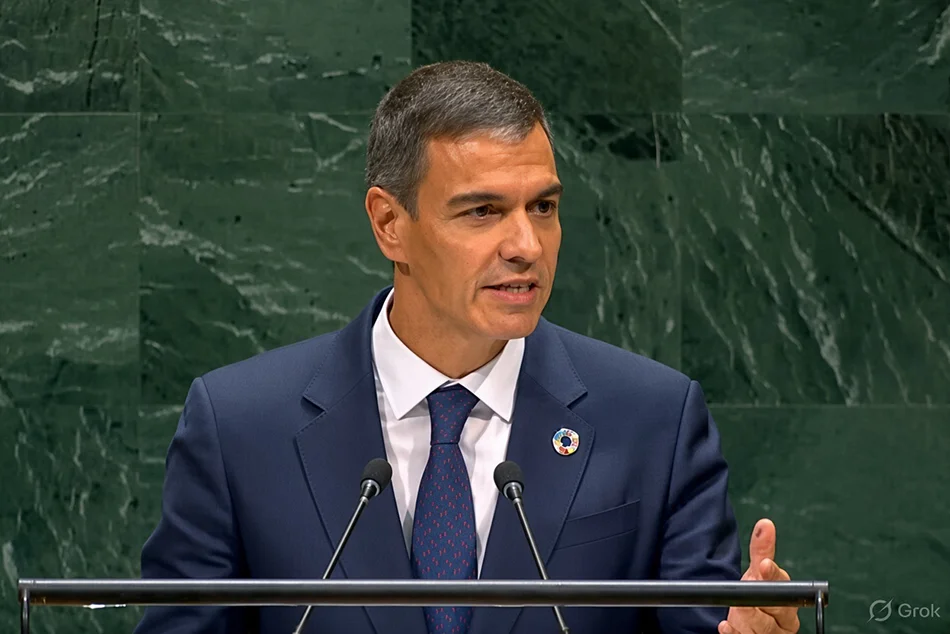
Pedro Sánchez stood at the tribune of the 81st General Assembly and reaffirmed Spain’s 'unequivocal' condemnation of 'the genocide that Netanyahu continues to perpetrate in Gaza'.
Begin with the image, because it says everything before anyone has opened their mouth. At the United Nations General Assembly this week, the Palestinian president addressed the world from a pre-recorded video played on a screen — the United States had denied him a visa, which is an elegant, administrative way of forbidding a people from speaking about their own death.
Meanwhile, the man under an International Criminal Court arrest warrant for crimes against humanity walked to that same podium in person, head held high, shielded by the power that refuses to see justice done. That is not irony. That is the architecture of impunity: the victim confined to a video feed, the suspect given a chair, a microphone, and forty minutes.
Credit where it is due
When Benjamin Netanyahu took the podium, much of the hall stood and walked out before he had begun. Dozens of delegations. One rarely sees an assembly of states vote this way — without a ballot, with their feet. Those who remained were treated to the full performance: genocide allegations were not merely false, they were “the biggest lie of the century.”
The departing delegates were promoted to “moral cowards”.
And the Mayor of New York, Zohran Mamdani — elected, that is, by New Yorkers, which in certain capitals still passes for an offense — received his “shame on you.” The Mayor of New York is not the point. He is simply the latest target of a method.
Let us stay for a moment in the arithmetic of the lie, since the accused has chosen numbers as his ground.
Gaza, Gaza Health Ministry figures, early September 2026: 73,914 dead, 174,995 wounded. Add the roughly ten thousand bodies no one has yet extracted from the rubble — clearance has not begun — and the UN itself fears a total approaching one hundred thousand. Nearly 90 percent of civilian infrastructure destroyed; seventy billion dollars to rebuild a world that was first reduced to dust.
And the crowning argument of those who say “the war is over”: since the ceasefire of October 10, 2025 — a ceasefire — more than a thousand Palestinians, 1,394 at the latest count, have still been killed, while food, medicine, and shelter materials remain blocked for two and a half million human beings.
A “lie”, then.
Seventy-three thousand nine hundred and fourteen times, the same lie, each with a name, a date of birth, sometimes a death certificate that the ministry can no longer issue for want of paper, ink, or a building to issue it from.
A lie that would have required, apparently, the complicity of the UN Commission of Inquiry, of human rights organisations worldwide, of legal scholars who specialise in genocide law — and, last week, of a General Assembly hall that emptied itself. So many accomplices. When a lie requires a conspiracy of this scale, it is no longer a lie: it is a theology.
Donald Trump brought the imperial version of the same method to the same podium. Thirty-eight minutes of remarks; a single mention of Israel. Note the economy of the genre: the president who recognised Jerusalem, killed the Iran nuclear deal, and promised to turn Gaza into a “Riviera” somehow found little to say about the only subject poisoning the room. He was considerably more voluble on the International Criminal Court, which he summoned all member states to quit immediately — a “rogue institution.”
The logic is clear and deserves to be written plainly, because it is the governing doctrine of the age: international law is legitimate when it incarcerates the weak; the moment it turns its attention to the powerful, it becomes a racket. One then withdraws contributions, cuts visas, declares the institution “useless” — and presents it a goodwill cheque for twenty points of a “peace plan” whose humanitarian bank account, we are told, remains empty. Impunity is no longer a state of affairs; it is a programme, funded, presented, and argued.
And Nasser Bourita?
Morocco’s Foreign Minister Nasser Bourita spoke at length: about the Sahara, about armed groups, about the Kingdom’s bid for a Security Council seat — and, as an obligatory passage, about a ceasefire and humanitarian aid for Gaza.
Let us not put words in his mouth: he did say the humanitarian words. But there is a distance, which protocol cannot measure, between calling for aid for the dying and ceasing to shake the hand of those who are killing them.
Morocco normalised relations with Israel, signed the Abraham Accords, opened its airspace and its markets — and now comes to New York seeking a judge’s seat among the judges of international law.
One cannot argue for civilian protection in the morning and countersign normalisation in the afternoon without someone, somewhere, noticing the gap. Rabat’s chair at the UN was not empty. That may be worse: it was occupied, and well polished.
The man who said the word
Then comes the man who said the word — and what distinguishes him is not virtue. It is the bill he has been willing to pay.
Pedro Sánchez stood at the tribune of the 81st General Assembly and reaffirmed Spain’s “unequivocal” condemnation of “the genocide that Netanyahu continues to perpetrate in Gaza.” He named the mechanism of denial more precisely than any editorial writer: first you question the rules, then you break them, then you cut the funding, then you express surprise that the edifice is shaking — a planned and coordinated dismantling of multilateralism.
Sánchez also called for reforming the Security Council to abolish the permanent members’ veto power, because, as he put it, no country should be a judge in its own case, however powerful.
And he paid.
This detail is essential, because it is what separates rhetoric from courage: Spain has made its arms embargo permanent by decree-law, barred ships resupplying the Israeli military from its ports, closed its airspace to military materiel bound for Gaza, banned those responsible for alleged crimes from entry, boycotted settlement products, recognised the State of Palestine, and committed 150 million euros in humanitarian aid. The response was swift: Netanyahu compared him to the Inquisition, and Madrid recalled its ambassador. To accuse of anti-semitism the man who names a genocide is the last conjuring trick of a propaganda that has run out of arguments. When you can no longer answer the fact, you answer the face.
Here, then, is the indictment. And let it not be mistaken for anger — it is an inventory.
Against Netanyahu and his government, who massacre, who starve, who then declare “a lie” the testimony of their own victims — with the method of the arsonist who files a complaint about the smell of smoke. Against Trump, who turns the UN into a stage for his personal legend, arms the denial, places international justice in the dock, and claims to resolve a genocide through a banking committee whose humanitarian account remains empty. Against those who normalise, temporise, and dream of sitting among the arbiters of law without ever wishing to pay the moral cost of arbitration.
And for Sánchez, the gratitude must be political, not sentimental. He said what everyone sees — but above all, he accepted what everyone else is avoiding:
The bill.
His formulation deserves to outlast the speech: there are “causes worth fighting for, even if winning them does not depend on us alone.” That is precisely what the powerful of this week refused to hear: that one can lose while fighting, and lose infinitely more by not fighting at all.
History — which is an accountant without humour — will not remember the twenty points of the “Board of Peace,” the thirty-eight minutes, or the visa hunt. It will remember three things: who massacred, who applauded — and who, in a hall where the Palestinian president did not even have the right to enter, had the glacial decency to say the right word.
The only lie in that hall on Thursday was the one delivered from the podium — by a man in a suit, before an assembly that had the dignity to empty itself before he had finished speaking.
[The writer, Laala Bechetoula, is an independent Historian, Journalist and Geopolitical Analyst, Algeria.]
Follow ummid.com WhatsApp Channel for all the latest updates.
Select Language to Translate in Urdu, Hindi, Marathi or Arabic