Maulana Fazlur Rehman: An Indian Supporter In Pakistan
Pakistani opposition leader and Chief of the Jamiat Ulema-e-Islam (JUI-F), Maulana Fazlur Rehman delivered a pointed critique of Pakistan’s military leadership, specifically targeting Army chief Asim Munir and the country’s policy toward Afghanistan
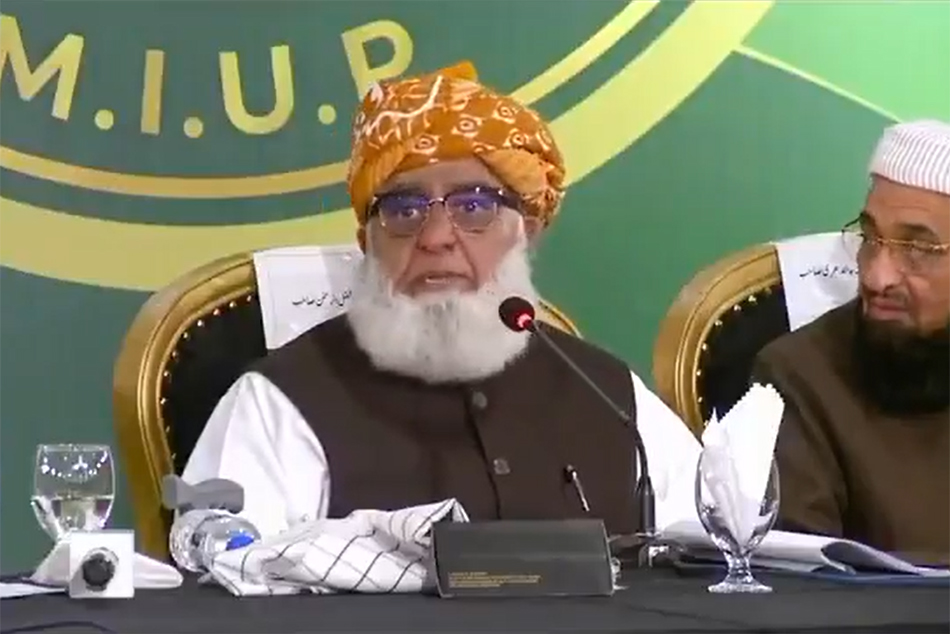
India recently got support in its fight against cross-border terrorism, from an unexpected quarter. Several Pakistani religious scholars and representatives of various religious sects stressed at a meeting that Afghan territory must not be used by the Tehreek-e-Taliban Pakistan (TTP) against Pakistan.
In a joint statement issued on Tuesday, December 23, 2025, the scholars said that turning Afghanistan into a sanctuary for such groups would undermine stability and damage relations between the two countries.
Maulana Fazlur Rehman posed a direct challenge to the military's justification for targeting militant groups in Afghanistan, drawing a sharp comparison to India's actions in Pakistan. Pakistani opposition leader and chief of the Jamiat Ulema-e-Islam (JUI-F), Maulana delivered a pointed critique of Pakistan’s military leadership, specifically targeting Army chief Asim Munir and the country’s policy toward Afghanistan.
Maulana especially called out Munir and the Pakistani military regime's contradicting stands on its actions against Afghanistan and India's actions taken under Operation Sindoor on its territory earlier this year. He was speaking at a religious gathering in the Pakistani town Lyari - alocality in Karachiwhich has been in the limelight in India after it served as the backdrop for the super-hit spy-gangster movieDhurandhar.
In his remarks, Rehman questioned the rationale behind Islamabad’s cross-border strategy. He posed a direct challenge to the military’s justification for targeting militant groups in Afghanistan, drawing a sharp comparison to India’s actions in Pakistan.
"If you justify attacking Afghanistan by claiming you are targeting your enemy there, then why do you object when India targets its enemy in Bahawalpur and Muridke (inside Pakistan)?" Rehman asked.
Rehman's JUI-F has 10 members in Pakistan's National Assembly, being the largest among opposition parties. However, 75 Independent members, backed by the Imran Khan-led Pakistan Tehreek-e-Insaf (PTI) form the largest Opposition bloc.
Taking aim at the Pakistani military leadership, Rehman continued to press the issue of policy consistency. "If you justify attacks on Kabul by claiming your enemies are present there, then why is your response different when India targets its enemies inside Pakistan?" he said.
Rehman’s comments come amid renewed exchanges of hostilities between Pakistani and Afghan forces. Cross-border clashes and airstrikes in recent months have heightened instability in the region. Both sides have traded accusations over ceasefire violations and responsibility for escalating violence.
The cleric warned that such military action is counterproductive. He stated, "If Afghanistan is attacked on the pretext that enemies are present there, then why the objection when India targets its enemies within Pakistan (in Bahawalpur and Muridke)?" His remarks highlight a perceived double standard in Pakistan’s security approach.
Rehman’s critique coincides with a period of internal debate in Pakistan over its security policy and use of force across borders. The ongoing tensions have not only strained Kabul-Islamabad relations but have also drawn regional and international concern over the risk of further destabilisation.
Rehman also called for restraint and dialogue as both sides accuse each other of supporting cross-border militant activity. Pakistan alleges that militants from the Tehreek-e-Taliban Pakistan (TTP) operate from Afghan territory, while Kabul denies the charges and claims Pakistan shelters hostile groups and violates Afghan sovereignty with airstrikes.
Rehman’s remarks at the "Pakistani Ummah Unity" programme emphasised the need for a consistent and principled foreign policy.
Pertinently, Rehman’s views stem from his ethos and religious training, which were imparted to him at his alma mater in India, i.e. DarulUloom, Deoband.
Rehman was in India last time in 2003, when he had a meeting with the then prime minister Atal Bihari Vajpayee at 7, RCR. The meeting scheduled for 15 minutes continued for more than two hours, as I waited outside with other press colleagues to have a byte from the Maulana.
Further, it would be prudent for the Indian establishment to engage with people like Maulana Fazlur Rehman and his old institution in India if it wants to tackle the allegedly growing extremism amongst the Indian Muslims in a humane manner. As the academics from Deoband, not the political figures associated with the institution, offer the most sensible approach and authority to deliver messages and programmes counter such tendencies in India.
Follow ummid.com WhatsApp Channel for all the latest updates.
Select Language to Translate in Urdu, Hindi, Marathi or Arabic