NASA explorer solves Black Hole jets mystery
A team of NASA astronomers using its IXPE (Imaging X-ray Polarimetry Explorer) has identified the origin of X-rays in a supermassive black hole’s jet, answering a question that has been unresolved since the earliest days of X-ray astronomy
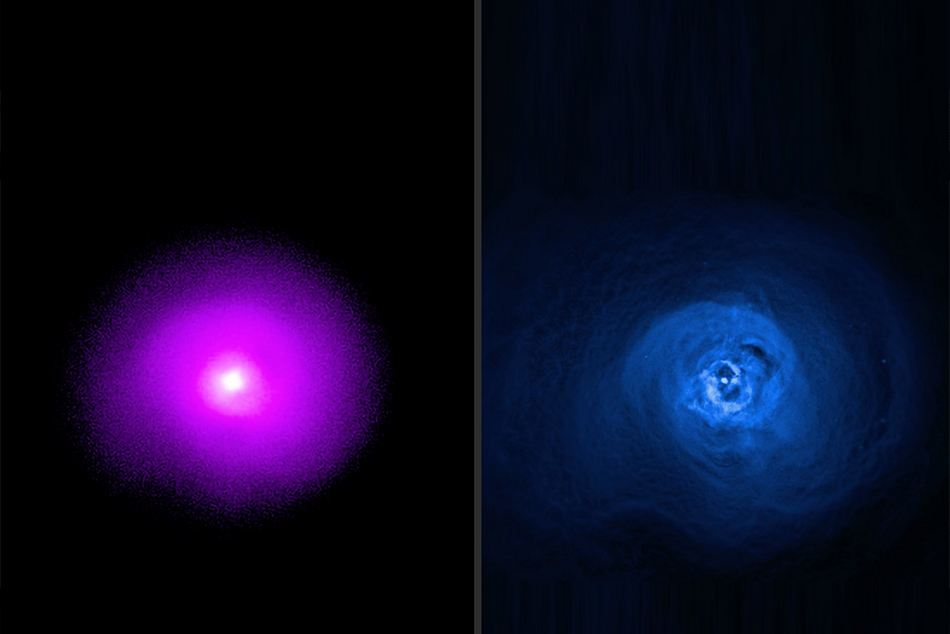
[Two composite images show side-by-side observations of the Perseus Cluster from NASA’s IXPE (Imaging X-Ray Polarimetry Explorer) and Chandra X-ray Observatory. Scientists used data from both observatories, along with data from Nuclear Spectroscopic Telescope Array (NuSTAR), and Neil Gehrels Swift Observatory, to confirm measurements of the galaxy cluster. X-ray: (Chandra) NASA/CXC/SAO, (IXPE) NASA/MSFC; Image Processing: NASA/CXC/SAO/N. Wolk and K. Arcand]
Washington: A team of NASA astronomers using its IXPE (Imaging X-ray Polarimetry Explorer) has identified the origin of X-rays in a supermassive black hole’s jet, answering a question that has been unresolved since the earliest days of X-ray astronomy.
The IXPE mission observed the Perseus Cluster, the brightest galaxy cluster observable in X-rays, for more than 600 hours over a 60-day period between January and March.
IXPE’s longest observation
Not only is this IXPE’s longest observation of a single target to date, it also marks IXPE’s first time observing a galaxy cluster, the American space agency said.
The NASA astronomers specifically studied the polarization properties of 3C 84, the massive active galaxy located at the very center of the Perseus Cluster.
"This active galaxy is a well-known X-ray source and a common target for X-ray astronomers because of its proximity and brightness", NASA said.
Perseus Cluster hosts an enormous reservoir of X-ray emitting gas - as hot as the core of the Sun, because it is very huge and massive.
Use of multiple X-ray telescopes
The use of multiple X-ray telescopes, particularly the high-resolution imaging power of NASA’s Chandra X-ray Observatory was essential to disentangle the signals in the IXPE data.
"Scientists combined these X-ray measurements with data from the agency’s Nuclear Spectroscopic Telescope Array (NuSTAR) mission and Neil Gehrels Swift Observatory", NASA said.
The findings have been published in The Astrophysical Journal Letters, by the American Astronomical Society on November 11, 2025.
Seed Photons
Polarization measurements from IXPE carry information about the orientation and alignment of emitted X-ray light waves. The more X-ray waves traveling in sync, the higher the degree of polarization.
X-rays from an active galaxy like 3C 84 are thought to originate from a process known as inverse Compton scattering, where light bounces off particles and gains energy. The polarization measurements from IXPE allow us to identify the presence of either inverse Compton scattering or other scenarios.
“Seed photons” is the term for the lower-energy radiation undergoing the energizing process of inverse Compton scattering. One may remember the Perseus Cluster from this sonification replicating what a Black Hole sounds like from May 2022.
“While measuring the polarization of 3C 84 was one of the key science goals, we are still searching for additional polarization signals in this galaxy cluster that could be signatures of more exotic physics,” said Steven Ehlert, project scientist for IXPE and astronomer at NASA’s Marshall Space Flight Center in Huntsville.
Follow ummid.com WhatsApp Channel for all the latest updates.
Select Language to Translate in Urdu, Hindi, Marathi or Arabic